Revenue Cycle Management Services for Medical Practices: What Providers Need to Know
Revenue cycle management services cover everything from patient scheduling and eligibility verification through coding, claim submission, denial management, and collections. This guide explains what these services include, why so many practices are struggling with denials and slow reimbursement, and how Maryland medical practices should evaluate an RCM partner.

A medical practice can deliver excellent patient care and still struggle financially if the business side of medicine isn't running well. Revenue cycle management is the business side of medicine, and for many physicians and practice administrators, it's also the part of the operation that gets the least attention until something goes wrong.
This guide breaks down what revenue cycle management services actually include, why the revenue cycle has become harder to manage in recent years, and what practice owners across Maryland, from Baltimore and Bethesda to Columbia, Frederick, and Salisbury, should look for when deciding whether to bring in outside help.
What Are Revenue Cycle Management Services?

Revenue cycle management, often shortened to RCM, refers to the entire financial process a medical practice goes through from the moment a patient schedules an appointment to the moment the practice is fully paid for the service provided. Revenue cycle management services are the specialized administrative and billing functions, whether performed in-house or by an outside company, that keep this process moving correctly and keep revenue from getting stuck along the way.
The revenue cycle isn't a single task. It's a chain of dependent steps, and a breakdown at any point in that chain can delay or reduce payment. Those steps generally include patient scheduling and registration, insurance eligibility verification, prior authorization when required, medical coding, claim submission, payer adjudication, payment posting, denial management, and patient billing for any remaining balance.
When people talk about "medical billing," they're usually referring to only part of this chain, the claim submission and payment posting steps. Revenue cycle management is the broader discipline that includes everything upstream and downstream of billing, which is exactly why problems that show up as a billing issue often actually originate somewhere else in the process, such as an eligibility check that was skipped or a prior authorization that was never obtained.
Why Revenue Cycle Management Matters More Than Ever
Medical billing has become more complex, not less, over the past several years. Payer requirements change frequently, prior authorization rules vary by plan, coding updates arrive every year, and claim denials have become more common across the industry. According to MGMA benchmarking data, the median denial rate reported by medical groups has hovered around 11 to 12 percent of submitted claims in recent surveys, and a meaningful share of denied claims are never reworked or resubmitted at all, meaning revenue is often lost permanently rather than simply delayed.
MGMA's Days in Accounts Receivable benchmark data shows a wide performance gap between typical practices and top performers. Median practices have historically reported Days in A/R in the mid-40s, while top-performing practices keep that number closer to the mid-30s or lower. That gap of ten or more days represents real cash sitting uncollected in a practice's receivables, month after month.

HFMA has similarly reported that clean claim rates, the percentage of claims accepted by a payer on first submission without correction, can range broadly across practices, with well-run revenue cycle operations reaching the high 90s and weaker operations falling well below that. Every percentage point below a strong clean claim rate translates into rework, delayed payment, and staff time that could otherwise go toward patient care or growth.
For Maryland practices specifically, there's an added layer of complexity. Maryland's all-payer hospital rate-setting system, overseen by the Health Services Cost Review Commission, and the state's transition from the Total Cost of Care Model to the AHEAD Model, add a payment structure that doesn't exist in most other states. Practices in Baltimore, Columbia, Rockville, and Frederick that work closely with hospital systems under these models need billing processes that account for Maryland-specific payer rules in addition to standard Medicare and commercial payer requirements.
What Revenue Cycle Management Services Actually Include
A full-service RCM engagement typically covers the following functions, either individually or as a bundled service.
- Patient scheduling and registration, capturing accurate demographic and insurance information at the first patient touchpoint. Errors here, a misspelled name, an outdated insurance ID, a wrong date of birth, are among the most common and most preventable causes of claim denials.
- Insurance eligibility and benefits verification, confirming active coverage, plan type, copay and deductible amounts, and referral or authorization requirements before the patient is seen.
- Prior authorization management, tracking which services require authorization, submitting requests with the correct clinical documentation, and following up before authorizations expire, especially relevant for radiology practices billing advanced imaging.
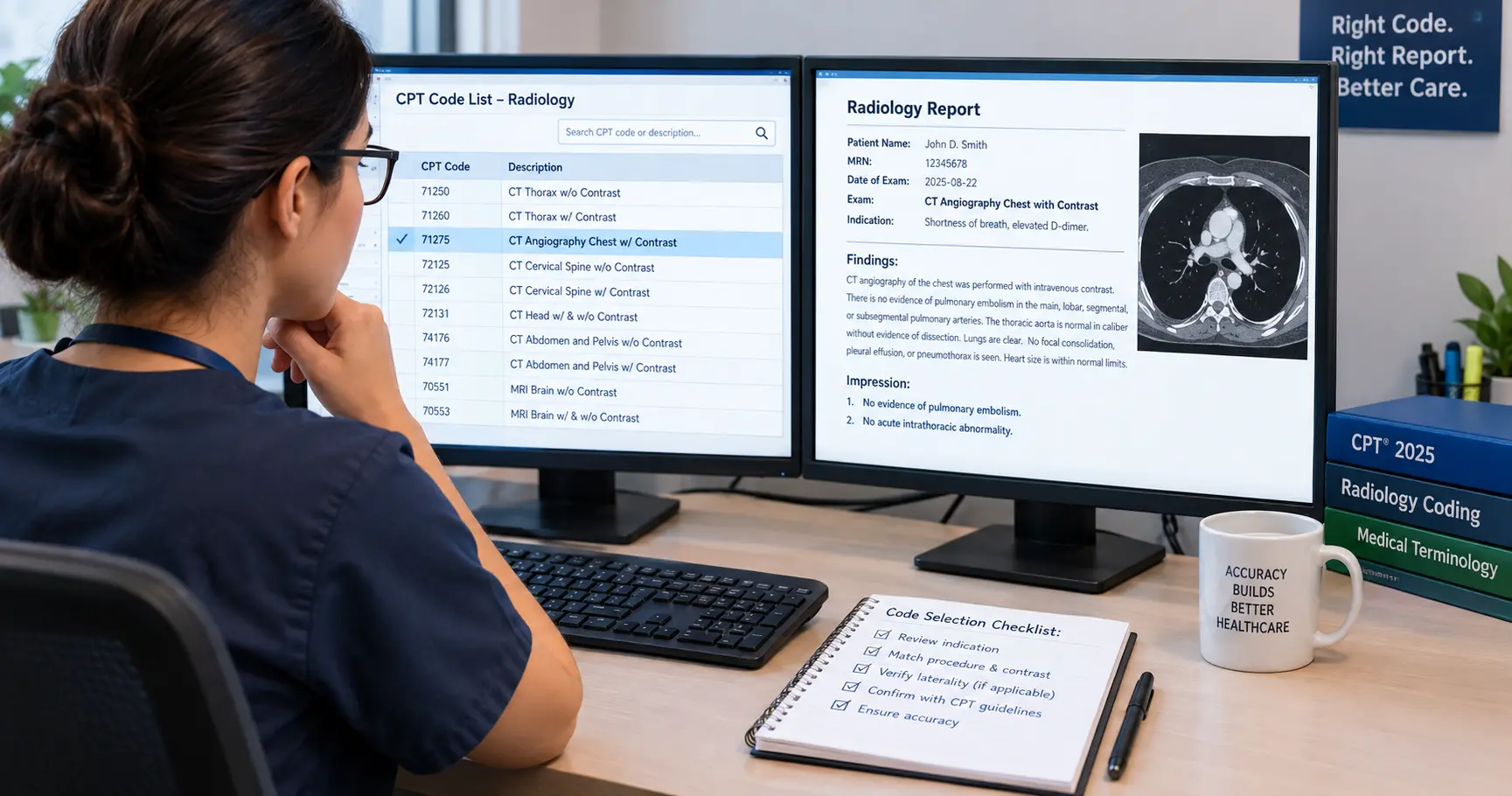
- Medical coding, translating clinical documentation into accurate CPT, HCPCS, and ICD-10 codes that reflect the service actually performed and support medical necessity.
- Claim submission and scrubbing, reviewing claims for errors before submission, checking for missing modifiers, mismatched codes, or incomplete information.
- Payer adjudication monitoring, tracking claim status after submission rather than waiting passively for a remittance.
- Payment posting and reconciliation, accurately posting payments and adjustments from remittance advice documents and flagging underpayments that don't match the contracted rate.
- Denial management and appeals, identifying why a claim was denied, correcting the underlying issue, and resubmitting or appealing within payer-specific timely filing windows.
- Patient billing and collections, generating accurate patient statements for remaining balances and managing payment plans in a way that protects the practice's relationship with its patients.
- Reporting and analytics, ongoing visibility into Days in A/R, clean claim rate, denial rate by payer and reason code, and net collection rate, so practice leadership can see trends before they become serious problems.
Common Revenue Problems Practices Face Without Strong RCM
Most practices don't lose revenue in one dramatic event. They lose it in small, repeated ways that add up over a year.
- Eligibility errors caught too late, a patient is seen, the claim is submitted, and only then does the practice learn coverage had lapsed or the plan required a referral.
- Prior authorizations that expire or are never obtained, particularly common for imaging-heavy specialties, resulting in a full denial for a service that was clinically appropriate.
- Coding errors and missing modifiers, a persistent issue in radiology professional and technical component billing, where a missing or incorrect modifier 26 or TC can result in a denied or underpaid claim.
- Denials that are never worked, industry data consistently shows a large share of denied claims are simply written off rather than appealed, even though many are recoverable with the right documentation.
- Timely filing deadlines missed, once a payer's filing window closes, the revenue is generally gone permanently, regardless of whether the underlying service was medically appropriate.
- Underpayments that go unnoticed, without systematic reconciliation against the contracted fee schedule, a practice can be paid less than it's owed for months without anyone catching it.
None of these problems are unique to any one specialty or region, but they tend to hit harder in states like Maryland, where the payer mix includes standard commercial insurance and Medicare Advantage plans alongside Maryland's distinct hospital rate-setting framework, adding another layer of rules that billing staff need to track.
How RCM Services Help Recover Revenue That Is Already Stuck
One of the most valuable things a strong revenue cycle management process does is not just prevent future problems, but recover revenue that's already sitting unresolved in a practice's receivables.
This usually starts with an audit of the current accounts receivable, sorting outstanding claims by age, payer, and denial reason. Claims still within a payer's appeal window get prioritized for rework. Claims involving underpayments get compared against the practice's actual contracted rates. Claims denied for a documentation issue that can still be corrected get resubmitted with the missing information.
This kind of systematic cleanup is exactly the work that tends to fall to the bottom of the list in a busy practice, not because staff don't care, but because there are only so many hours in a day and denial rework competes directly with front-desk and clinical support duties. A dedicated RCM function, in-house or outsourced, exists specifically to make sure this work doesn't get deprioritized indefinitely.
In-House Billing vs. Outsourced Revenue Cycle Management
There's no universally correct answer to whether a practice should keep billing in-house or outsource it. Both models can work well, and both can fail if not properly resourced.
In-house billing gives a practice direct control over its staff and processes, and can work well with experienced billing personnel, low staff turnover, and manageable claim volume. The tradeoff is ongoing investment in staff training, payer rule updates, coding certification, and billing software, and a small team can be significantly disrupted by a single employee leaving or being out sick.
Outsourced revenue cycle management shifts the day-to-day billing workload, and often the associated staffing risk, to a specialized company. A good RCM partner brings dedicated coding and billing staff, established denial management workflows, and reporting that gives practice leadership visibility without requiring them to manage the process personally. The tradeoff is that the practice is trusting an outside partner with a critical financial function, which makes partner selection and ongoing communication genuinely important.
Many practices land on a hybrid approach, keeping functions such as scheduling in-house while outsourcing coding, claim submission, and denial management to a specialized partner.
When a Practice Should Consider Outsourcing RCM
There isn't a single trigger that means a practice must outsource, but there are common signals worth paying attention to.
- Days in A/R has been trending upward for several consecutive months.
- Denial rates are climbing and staff don't have time to work denials consistently.
- The practice is growing and adding providers faster than billing staff capacity can keep up with.
- A key billing staff member has left or is planning to leave, and institutional knowledge is at risk.
- The practice is expanding into a new specialty or new payer contracts and needs coding expertise it doesn't currently have in-house.
- Leadership has limited visibility into billing performance and finds out about problems only after they've already affected cash flow.
Practices in growing Maryland communities such as Towson, Silver Spring, Bel Air, and Waldorf, adding locations or expanding into new specialties, often find that this is exactly the point where billing complexity outpaces what a small in-house team can reasonably manage.
What to Look for in a Revenue Cycle Management Partner
Not all RCM companies operate the same way, and the difference matters. When evaluating a potential partner, practices should look closely at the following.
- Specialty-specific experience. Radiology billing, with its professional and technical component distinctions, is meaningfully different from internal medicine billing, with its emphasis on evaluation and management coding and chronic care management. A partner should speak concretely to the coding and payer nuances of the practice's specific specialty.
- Transparent reporting. A practice should have ongoing access to clear reporting on Days in A/R, denial rates by reason and payer, and collection rates, rather than relying on a vendor's word that things are going well.
- A real denial management process. Ask specifically how denials are worked, not just whether they're worked. A partner should describe a process for categorizing denials, prioritizing appeals by dollar value and recoverability, and tracking timely filing deadlines.
- Credentialing and payer enrollment support. Billing and credentialing are closely connected. A practice delayed in payer enrollment can't bill that payer at all, regardless of how strong its coding is.
- Compliance awareness. A trustworthy partner follows current CMS and payer guidance rather than cutting corners on documentation or coding to inflate short-term collections, since aggressive or inaccurate billing creates real audit and compliance risk for the practice.
- Communication and accessibility. Practices should be able to reach a real person with billing questions rather than submitting a ticket into a queue with no clear response time.
How RCM Services Support Different Specialties
Revenue cycle management isn't one-size-fits-all. The core process is the same across specialties, but the details that determine whether a claim gets paid correctly differ significantly.
Radiology billing depends heavily on correctly applying modifier 26 for the professional component, modifier TC for the technical component, or billing globally when a single entity performs both. Radiology practices in Maryland also face prior authorization requirements from radiology benefit managers on behalf of commercial and Medicare Advantage payers, particularly for advanced imaging such as MRI and CT.
Internal medicine practices depend on accurate evaluation and management coding, and increasingly on correctly billing chronic care management and remote patient monitoring codes as more practices adopt these care models. Internal medicine practices also tend to see higher patient volumes with more frequent, lower-dollar visits, making efficient claim scrubbing and eligibility verification especially important, since errors compound quickly across volume.
Behavioral and mental health billing involves its own set of coding and documentation nuances, including time-based codes and payer-specific session limits, along with credentialing requirements that can differ from medical specialties.
An RCM partner working across multiple specialties should adapt its coding review, denial management, and prior authorization workflows to the specific rules that apply to each one, rather than applying a single generic process to every client.
Frequently Asked Questions
What is the difference between medical billing and revenue cycle management?
Medical billing typically refers to claim submission and payment posting. Revenue cycle management is the broader process that includes everything from patient scheduling and eligibility verification through coding, claim submission, denial management, and patient collections.
How much does outsourced revenue cycle management typically cost?
Pricing models vary by company and typically involve either a percentage of collections or a flat monthly fee, and the right structure often depends on a practice's claim volume, specialty, and specific service needs. Because pricing structures vary meaningfully between vendors, practices should request a clear breakdown of what's included before comparing costs.
Can a practice outsource only part of its revenue cycle, such as denial management?
Yes. Many RCM companies, including Edge RCM, offer support for specific functions such as denial management, credentialing, or prior authorization rather than requiring a practice to outsource its entire billing operation.
How long does it take to see results after switching to an RCM partner?
Timelines vary, but practices often begin seeing measurable improvement in clean claim rates and denial resolution within the first few months, while full stabilization of Days in A/R and collection rates can take longer, particularly if there's a backlog of aged accounts receivable to work through.
Does Maryland's healthcare payment system affect how RCM services work here?
Yes, to an extent. Maryland's all-payer hospital rate-setting system and its transition to the AHEAD Model primarily affect hospital-based payment structures, but practices that work closely with Maryland hospitals or participate in related care coordination models benefit from an RCM partner familiar with these state-specific frameworks in addition to standard payer billing rules.
Conclusion
Revenue cycle management isn't a back-office afterthought. It's the financial infrastructure that determines whether a practice actually gets paid for the care it provides, and how quickly. Practices that treat the revenue cycle as a strategic priority, whether by strengthening in-house processes or partnering with an experienced outside team, consistently see fewer denials, faster payment, and more predictable cash flow than practices that only address billing problems after they've already affected revenue.
For Maryland practices navigating a payer environment that includes standard commercial insurance, Medicare Advantage, Medicaid managed care, and the state's own hospital rate-setting framework, having a revenue cycle partner who understands both the national billing landscape and Maryland's specific rules can make a meaningful difference in financial performance.
Edge RCM CTA
Edge RCM, based in Reisterstown, provides revenue cycle management services for medical practices across Maryland, including practices in Baltimore, Columbia, Rockville, Frederick, Bethesda, and Salisbury, helping providers in radiology, internal medicine, and other specialties reduce denials, speed up reimbursement, and gain clear visibility into their billing performance. Edge RCM's approach covers eligibility verification, prior authorization support, accurate coding, clean claim submission, active denial management, and transparent reporting, so practice leadership always knows how the revenue cycle is performing. Whether your practice is looking to fully outsource its billing function or wants targeted support in a specific area such as denial management or credentialing, Edge RCM works as an extension of your team rather than a disconnected vendor.