7 Common Medicare Claim Denials: What They Mean and How Providers Can Prevent Them
A practical breakdown of the seven Medicare claim denial codes providers see most often, CO-50, CO-4, CO-16, CO-18, CO-29, CO-197, and CO-97, explaining what each one means, why it happens, and the specific steps a billing team can take to prevent and resolve it.
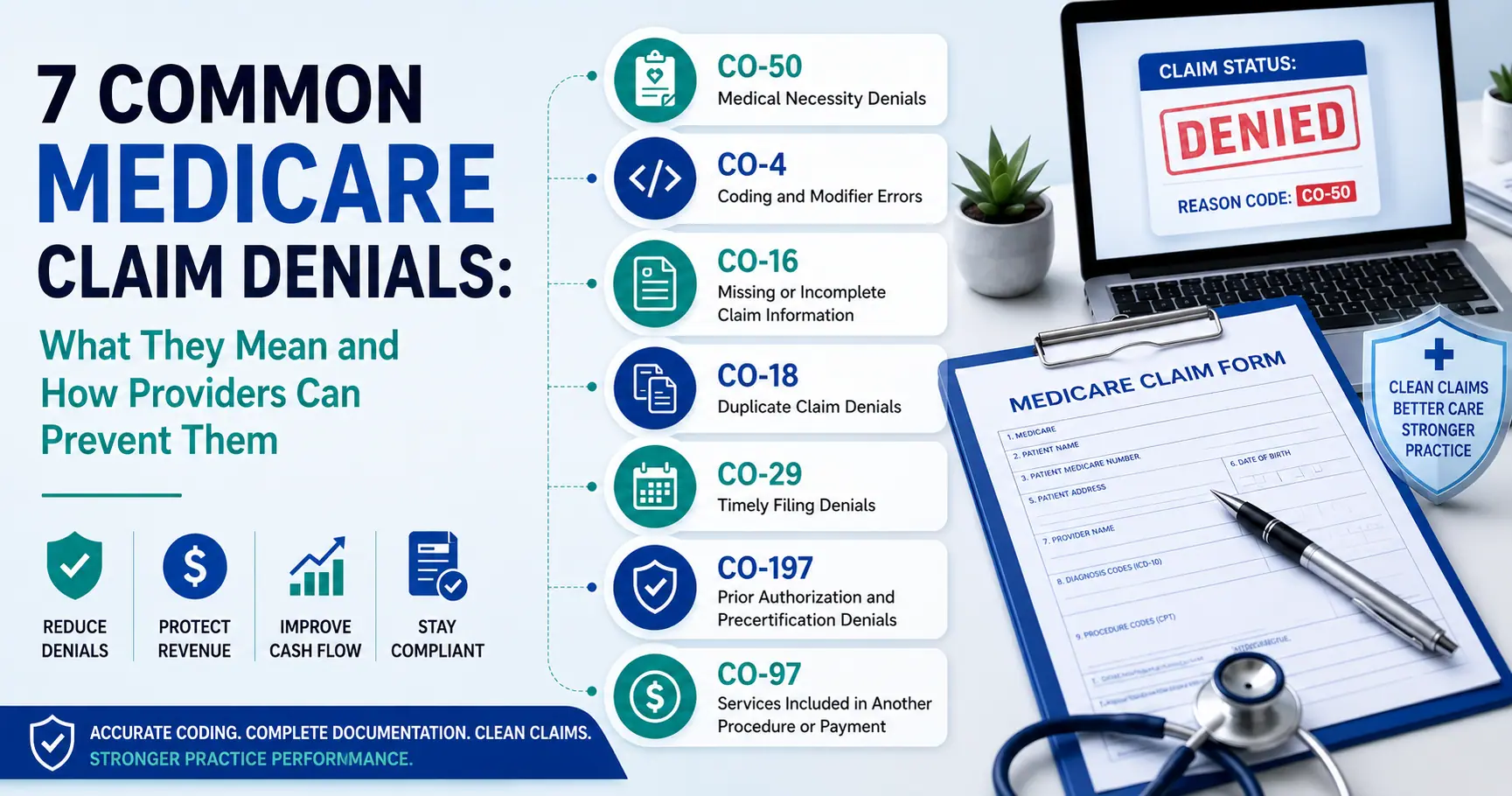
A Medicare claim denial can turn what should be a quick remittance check into a real headache. You're scanning through and there's a line item sitting at zero payment, paired with a code that might as well be alphabet soup, CO-50, CO-16, CO-97, take your pick. Whoever's handling billing needs answers fast: what does this code actually mean, is it fixable or does it need an appeal, and what went wrong in the first place?
Here's the thing, these denials aren't arbitrary. Claim Adjustment Reason Codes (CARCs) exist specifically to give a standardized explanation for why a claim was adjusted or denied, and Remittance Advice Remark Codes (RARCs) fill in additional detail on top of that. Once a billing team gets comfortable reading these codes, denial management stops feeling like guesswork and starts becoming something closer to routine. That's what this guide covers: seven Medicare denial codes you'll run into often, what typically triggers them, and the concrete steps providers can take to head them off before they happen.
Medicare Claim Denials: Why They Happen and Why Providers Should Care
Every CARC comes attached to a Group Code, and that pairing matters, it tells you how the adjustment is being assigned. There are three you'll see most: CO for contractual obligation, PR for patient responsibility, and OA for other adjustment. Providers need to look at the Group Code together with the CARC (and any RARC riding along with it), because that combination is what actually tells you what the adjustment means and what you're supposed to do about it. A number of the examples ahead involve the CO Group Code specifically, so it's worth double-checking the relevant Medicare rules before deciding whether something can be corrected, appealed, or passed along to the patient.
Not every denial deserves the same response, either. Sometimes it's just a coding or data slip-up, and a corrected claim fixes it outright. Other times you're looking at a medical necessity or coverage problem, which usually means pulling together documentation and, if it comes to it, filing an appeal. What you actually do next hinges on why the claim was denied, what the payer's guidelines say, and whether a correction will do or you're stuck going through the appeals process. Figuring out which category a denial falls into early on is what keeps a billing team from treating every single denial like it's the same problem.
CO-50: Medical Necessity Denials
What It Means
CO-50 means the payer determined the billed service was not medically necessary based on the diagnosis and documentation submitted. This is one of the most common denials in specialties that order frequent testing or imaging, cardiology included, where a service can be entirely appropriate clinically but still get denied because the claim did not clearly connect the diagnosis code to the medical justification for the service.
Why It Happens
- The diagnosis code billed does not match Medicare's local coverage determination for that specific procedure
- Documentation supports the service clinically but was not translated into the correct diagnosis code on the claim
- The ordering physician's note lacks enough detail to establish necessity under the applicable LCD or NCD
How to Prevent It
Check the relevant Local Coverage Determination before the service is performed whenever possible, not after the denial arrives. Build a habit of cross-referencing ordered tests against covered diagnosis lists during scheduling, and make sure clinical documentation explicitly supports why the service was ordered, not just that it was ordered.
CO-4: Coding and Modifier Errors
What It Means
CO-4 means the procedure code submitted is inconsistent with the modifier attached, or a required modifier is missing entirely. This is considered a soft denial because it is purely a coding accuracy issue, not a coverage or medical necessity problem.
Why It Happens
- A modifier was left off a code that requires one, such as a bilateral or multiple procedure modifier
- The modifier used does not apply to that particular CPT or HCPCS code
- Outdated coding software or a coder working from an old reference table applies a modifier combination that is no longer valid. Keeping up with annual CPT code changes is also important, since deleted, revised, or newly introduced codes can create additional billing and claim processing issues.
How to Prevent It
Keep your coding team's reference materials current with CMS's quarterly NCCI edits and modifier updates. A pre-submission scrub that specifically checks modifier and code pairing catches most CO-4 issues before the claim ever leaves your system.
CO-16: Missing or Incomplete Claim Information
What It Means
CO-16 means the claim or service is missing something adjudication requires, some piece of information just isn't there. There's usually a RARC riding alongside it that spells out exactly what's missing. Because CO-16 is such a catch-all reason, it's not something you want to read on its own; check what the accompanying code says before drawing conclusions.
Why It Happens
- A required field, like a referring provider number, was left blank on the claim
- Required claim information was incomplete, missing, or inconsistent with the payer's requirements
- Patient demographic or insurance information does not match what Medicare has on file
How to Prevent It
Always read the paired remark code, it tells you exactly what to fix. Build a claim scrubbing step into your workflow that checks for commonly missing fields before submission, and verify patient eligibility and demographic data at every visit, not just at initial intake.
CO-18: Duplicate Claim Denials
What It Means
CO-18 means the payer identified the claim as an exact duplicate of one already submitted and processed. It is a submission-process issue, not a medical necessity or coding problem, and treating it like one wastes valuable appeal time.
Why It Happens
- A claim was resubmitted before the original had finished processing, often out of impatience with a slow payer turnaround
- A billing system or clearinghouse glitch sent the same claim twice
- A corrected claim was submitted without the proper frequency code, so the payer's system read it as a fresh duplicate instead of a correction
How to Prevent It
Always check claim status through your clearinghouse or the Medicare Administrative Contractor's provider portal before resubmitting anything. If you are correcting a previously submitted claim, use the correct claim frequency code so the system recognizes it as a correction rather than a new submission.
CO-29: Timely Filing Denials
What It Means
CO-29 shows up when a claim gets submitted past the filing deadline. Original Medicare generally gives you 12 months from the date of service, though there are exceptions and other Medicare rules that can shift that window. The smart move is to track filing deadlines on your own timeline, not wait until you're bumping up against the federal cutoff.
Why It Happens
- A claim sat unbilled in a queue due to a documentation or coding backlog
- An initial claim was rejected for a correctable error, and the correction and resubmission cycle ran past the twelve-month window
- Coordination of benefits delays with a secondary payer pushed the Medicare submission past deadline
How to Prevent It
Track claims against filing deadlines from the date of service, not from when documentation happens to be finished.Set an internal filing deadline well before Medicare's applicable limit so your team has enough time to identify and correct rejected or incomplete claims before the filing deadline approaches.
CO-197: Prior Authorization and Precertification Denials
What It Means
CO-197 means the payer determined that required prior authorization, precertification, or notification was not obtained before the service was rendered, or that the authorization on file does not match what was actually billed. If you're working from older billing references, you might still see CARC 62 mentioned, but X12 retired that one. Best to lean on current CARC definitions and whatever guidance the payer has published now, rather than trusting outdated material.
Why It Happens
- The authorization request was never initiated for a service that required one
- The authorization obtained was for a different procedure code than what was ultimately performed
- The authorization expired before the service date, or the units or visit count on the claim exceeded what was approved
How to Prevent It
Build a standardized pre-visit checklist that flags any service on your payer's prior authorization list before it is scheduled. For Medicare Advantage providers, prior authorization requirements and denial patterns can create additional administrative challenges, particularly when a request requires further documentation or an appeal. Track authorization numbers, approved units, and expiration dates in your practice management system so nothing slips through when a service date shifts. For Medicare Advantage plans specifically, remember that authorization rules can differ meaningfully from Original Medicare and even from plan to plan.
CO-97: Services Included in Another Procedure or Payment
What It Means
CO-97 means the benefit for the billed service is already included in the payment for another service or procedure that was adjudicated on the same claim or encounter. CO-97 tends to come up when a service is treated as already bundled into payment for another procedure. Medicare's NCCI Procedure-to-Procedure edits are a big driver of this kind of bundling denial, though it's worth checking the specific situation against current coding and payer rules rather than assuming.
Why It Happens
- A procedure was billed separately when it is actually a component of a more comprehensive code already billed
- A modifier that would allow separate payment, such as modifier 59, was needed but not applied, or was applied without documentation to support it
- The NCCI edit tables were updated and a code combination that used to be separately payable no longer
How to Prevent It
Run claims against current NCCI Procedure-to-Procedure edit tables before submission, and update those tables on the same quarterly cycle CMS uses. If a modifier like 59 is genuinely appropriate, make sure the documentation clearly supports two distinct, separately identifiable services rather than one procedure billed twice.
How Providers Can Prevent Common Medicare Claim Denials
Individually preventing each code above matters, but the practices with the lowest denial rates tend to share a few habits that cut across all seven.
Actionable Tips
- Verify eligibility and benefits at every visit, not just at the first appointment, since coverage and plan details can change
- Run a pre-submission claim scrub that checks for missing fields, modifier mismatches, and NCCI bundling conflicts before the claim ever reaches Medicare
- Track denial trends by CARC code monthly, not just total denial dollars, so you can see which specific problem is growing
- Assign clear ownership for prior authorization tracking so no request falls through when a service date changes
- Review Local Coverage Determinations for your most frequently billed high-dollar procedures at least twice a year, since they do get updated
Common Mistakes Practices Make
- Treating every denial the same way instead of matching the response to the specific denial reason, such as correcting claim data, reviewing documentation, or pursuing an appeal when appropriate
- Resubmitting a denied claim without first reading the paired remark code, which usually names the exact fix needed
- Letting claims sit in a documentation queue long enough that timely filing becomes a risk
- Assuming an authorization obtained for one procedure code automatically covers a related but different code performed on the day of service
Expert Recommendations
Build a denial dashboard that breaks volume down by CARC code and by provider or department. Patterns hide in aggregate numbers. A single provider generating a disproportionate share of CO-50 denials, for example, usually points to a documentation habit that a short conversation and template adjustment can fix, saving far more time than appealing each denial individually after the fact.
What to Review When a Medicare Claim Is Denied
When a denial lands, work through the same sequence every time so nothing gets missed.
- Read the CARC and the paired RARC together, since the remark code usually tells you exactly what element was missing or wrong
- Confirm the Group Code, CO, PR, or OA, so you know immediately whether the patient can be billed or the practice absorbs the adjustment
- Pull the original documentation and compare it against what was actually billed, checking for a mismatch between the clinical note and the submitted codes
- Check the payer's specific timeline for corrected claims versus formal appeals, since these deadlines and processes differ
- Document the root cause internally, even for a quick soft-denial fix, so your team can spot a recurring pattern before it becomes a habit
Frequently Asked Questions
What is the difference between a CARC and a RARC?
A Claim Adjustment Reason Code, or CARC, explains why a payer adjusted or denied a claim line. A Remittance Advice Remark Code, or RARC, adds specific detail, such as which exact field was missing. Reading both together, not just the CARC alone, gives you the full picture.
Can a patient be billed for a CO-denied claim?
A CO Group Code usually points to a contractual obligation that lands on the provider, not the patient, so that balance shouldn't get shifted over to patient responsibility automatically. Before any of it gets billed to a Medicare beneficiary, the practice needs to check the applicable Medicare participation, assignment, and beneficiary billing rules for that particular claim.
How long do providers have to appeal a Medicare denial?
With Original Medicare, you've generally got 120 days from when you receive the Medicare Summary Notice or remittance advice to file a first-level redetermination request though that's subject to Medicare's own rules and possible exceptions. It's worth confirming the actual deadline and filing requirements each time, since they can vary by claim and by appeal level.
What is the most common Medicare denial code overall?
Honestly, there's no single denial code that tops the list across every Medicare provider or specialty, it just doesn't work that way. What's driving denials depends on the specialty, the services being billed, how documentation and coding are handled, the payer type, even the patient population. The real move is pulling your own denial data and figuring out which CARCs are actually costing you the most, financially and operationally.
Is CO-50 always appealable?
It can be, if additional documentation supports medical necessity that was not clear on the original claim. A successful appeal typically requires submitting clinical notes that more clearly connect the diagnosis to the applicable coverage policy.
What happened to denial code CO-62?
X12 retired CARC 62 a while back, but you'll still run into it in older billing materials that haven't been updated. Current teams are better off working from active CARC definitions and whatever remittance information the payer has on file now, rather than leaning on references that are out of date.
Does timely filing apply differently to Medicare Advantage plans?
Yes, in some cases. While Original Medicare follows the twelve-month federal timely filing rule, Medicare Advantage plans can set their own filing deadlines within their contracts, so it is worth confirming the specific timeline for each MA plan you bill.
How can a practice reduce prior authorization denials specifically?
Build a standardized pre-service checklist tied to each payer's current prior authorization list, track approved units and expiration dates in your practice management system, and confirm the authorized procedure code matches what will actually be billed before the service is performed.
Why does the same procedure sometimes get a CO-97 denial and sometimes get paid?
NCCI edits and bundling rules are updated quarterly, so a code combination that was separately payable last quarter may be bundled this quarter, or vice versa. Keeping your coding team's edit tables current prevents this kind of denial from creeping back in unexpectedly.
Should a practice handle Medicare denials in-house or outsource them?
It depends on volume and internal bandwidth. Practices with a high denial volume or limited dedicated billing staff often benefit from a specialized revenue cycle partner who tracks CARC trends daily and can respond to appeals within payer deadlines without pulling clinical staff away from patient care.
Conclusion
Medicare denial codes are not designed to be confusing on purpose, they are designed to be consistent, which means every one of the seven codes above is preventable once your team understands the pattern behind it. The practices with the strongest reimbursement outcomes are not the ones with zero denials, that is close to impossible at any real claim volume. They are the ones that catch and correct denials fast, track the patterns behind them, and adjust their front-end workflow before the same mistake repeats.
If your practice is seeing a rising denial rate, struggling to keep up with prior authorization tracking, or simply wants a second set of eyes on your CARC trends, Edge RCM works with providers every day to turn denial data into a cleaner claims process. Our team stays current on CMS coding updates, NCCI edits, and payer-specific authorization rules so your staff can spend less time chasing denials and more time with patients. Reach out to Edge RCM to talk through where your denial patterns are coming from and how to close the gaps.