State medical licensing in any state, without losing a quarter to paperwork
State boards do not agree on much: not the forms, not the fees, not the verification vendors, not the fingerprint process, not even how long they take to answer the phone. We navigate all 50 of them every week, so your expansion timeline is driven by your strategy instead of by an application sitting in a reviewer's tray.
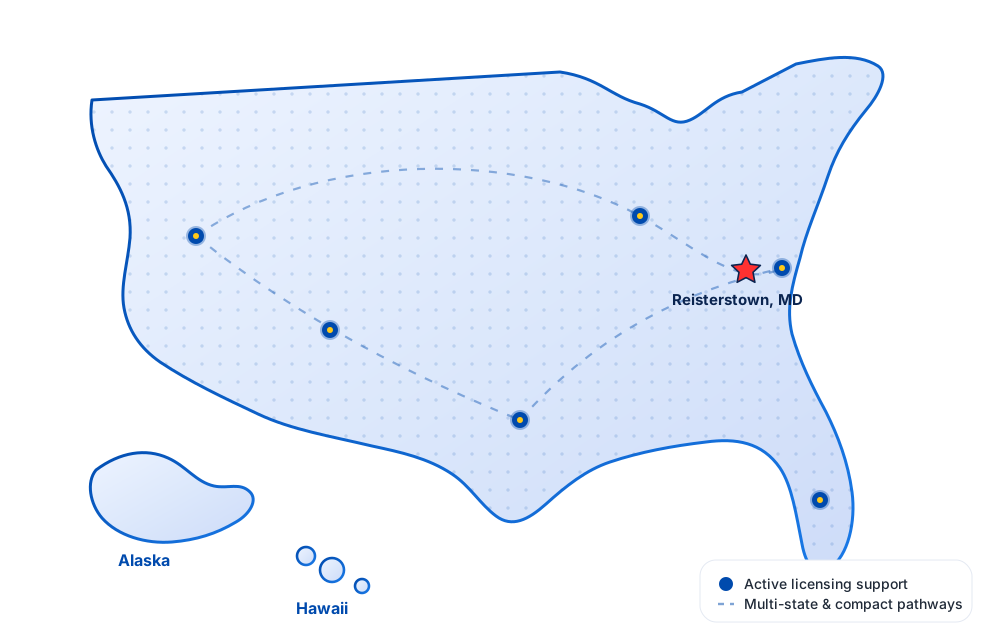
Serving all 50 states, plus D.C. and US territories
Wherever your patients are, we can get your providers licensed to treat them. Select a state during your consultation and we will send its specific requirements, fees and current processing times.
- Alabama
- Alaska
- Arizona
- Arkansas
- California
- Colorado
- Connecticut
- Delaware
- Florida
- Georgia
- Hawaii
- Idaho
- Illinois
- Indiana
- Iowa
- Kansas
- Kentucky
- Louisiana
- Maine
- Maryland
- Massachusetts
- Michigan
- Minnesota
- Mississippi
- Missouri
- Montana
- Nebraska
- Nevada
- New Hampshire
- New Jersey
- New Mexico
- New York
- North Carolina
- North Dakota
- Ohio
- Oklahoma
- Oregon
- Pennsylvania
- Rhode Island
- South Carolina
- South Dakota
- Tennessee
- Texas
- Utah
- Vermont
- Virginia
- Washington
- West Virginia
- Wisconsin
- Wyoming
- Washington D.C.
- Puerto Rico
Everything we handle on your behalf
From a single new license to a coordinated multi-state rollout for an entire provider group.
New State Licenses
Complete application preparation and submission: board forms, medical school and postgraduate training verifications, work history reconciliation, malpractice history explanations, jurisprudence exam registration, fingerprinting logistics and fee payment coordination, followed by weekly board follow-up until the license number is issued.
Renewals & CME Tracking
Renewal cycles are calendared 90 days out with continuing medical education requirements tracked per state, including specific mandates such as opioid prescribing, human trafficking recognition, implicit bias or pain management, which differ by jurisdiction and catch providers out every cycle.
DEA Assistance
Federal DEA registration applications, address and location changes, renewals, and the separate state controlled substance registration that many states require alongside the DEA. Expirations are monitored, because a lapse stops prescribing and creates pharmacy problems within days.
Compact License Guidance
Eligibility review and filing support for the Interstate Medical Licensure Compact for physicians, plus the Nurse Licensure Compact, PSYPACT for psychologists, and the physical therapy and occupational therapy compacts. Where you qualify, this is the fastest legitimate route to multi-state practice.
Telehealth Licensing
A state-by-state map of what your virtual practice actually needs: full licensure, telehealth registration, limited or special purpose licenses, in-state address requirements, modality restrictions and prescribing rules, turned into a sequenced rollout plan with realistic go-live dates.
License Monitoring
A single register of every license, DEA registration, certification and CME deadline across your entire provider group, with automated alerts at 90, 60 and 30 days. Nothing expires quietly, which matters because an expired license invalidates claims retroactively.
Verification
Primary source verification coordination with medical schools, residency and fellowship programs, prior employers, hospitals and other state boards, plus FCVS profile setup and maintenance, which shortens every future application you file.
Allied Provider Licensing
Nurse practitioners, physician assistants, registered nurses, psychologists, counselors, physical and occupational therapists, speech language pathologists and behavior analysts, including collaborative practice and supervision agreements where a state requires them.
Practice & Facility Registrations
Business entity registrations, foreign qualification filings, CLIA certificates for in-office labs, facility licenses and state-specific practice registrations that must be in place before a location can legally open its doors.
Six stages from decision to license number
Verifications are the long pole in every licensing project, so we start them on day one rather than after the board asks.
Eligibility Review
We confirm which pathway fits: full licensure, compact, endorsement, reciprocity or telehealth registration, and flag anything in your history that a board will ask about before you spend a dollar in fees.
Document Assembly
A secure checklist collects your diplomas, transcripts, training certificates, current licenses, DEA, malpractice history, CV and identity documents into one verified provider file.
Verification Requests
Primary source verification requests go out immediately to schools, training programs, employers and other boards, in parallel, not one at a time, because these are what set your finish date.
Application Filing
The application is completed, reviewed twice against the board's checklist, notarized where required and submitted with fees paid. Jurisprudence exams and fingerprint appointments are scheduled at the same time.
Board Follow-up
Weekly contact with the board analyst assigned to your file, immediate response to any deficiency notice, and a status update to you every time something moves. There is no silence for weeks at a time.
Issuance & Handoff
License issued, details logged into your monitoring register, renewal calendared, and the license number handed straight to our credentialing team so payer enrollment can begin the same day.
Why practices hand licensing to us
Licensing is a project management problem disguised as a paperwork problem. Practices lose months not because the work is difficult, but because nobody owns it full time.
- Providers stop doing admin. Clinicians spend under an hour on the whole process instead of evenings hunting for a residency certificate.
- No lapsed credentials. Centralized monitoring means a license, DEA or CME requirement never expires unnoticed and invalidates a month of claims.
- Faster expansion. Multi-state rollouts run in parallel with credentialing, so a new market opens in one timeline rather than two sequential ones.
- Fewer costly restarts. Applications rejected for incomplete information often mean re-paying fees and re-queuing. Ours are checked twice before filing.
- One source of truth. Every credential for every provider in one register your compliance officer can produce on demand.
How long licensing usually takes
Ranges reflect normal board processing when a complete application is submitted. Boards control the final timeline.
Planning to open in a new state this year?
Tell us the states. We will send requirements, fees and realistic timelines within one business dayStraight answers on state licensing
Have a state-specific question? Call +1 (855) 307-4535.
Typically 60 to 180 days, depending entirely on the board. States that require a monthly board meeting and heavy primary source verification sit at the long end, while states with rolling administrative approval can issue in six to eight weeks. Interstate Medical Licensure Compact applications are usually much faster once a letter of qualification is issued by your state of principal license.
It is an expedited pathway that lets qualifying physicians obtain full licenses in participating states without repeating the entire application in each one. Eligibility generally requires a full, unrestricted license in a compact member state that acts as your state of principal license, board certification, no disciplinary history and no pending investigations. We confirm your eligibility before you pay any fee, and where you do not qualify, we file the traditional application instead rather than leaving you in limbo.
In most cases, yes. The prevailing rule is that care is delivered where the patient is physically located, so you generally need a license in that state. Some states offer telehealth registrations, limited licenses or narrow exceptions for consultation and continuity of care, and those rules change. We map current requirements for the states you intend to serve so your expansion plan is built on what boards require today, not on what was true two years ago.
Yes. We assist with DEA registration applications and address changes, and we coordinate the separate state-level controlled substance registration where a state requires one in addition to the federal DEA. Expirations are tracked in your monitoring register, because a lapsed DEA registration interrupts prescribing and creates pharmacy and payer problems almost immediately.
Slow primary source verifications from medical schools and residency programs, unexplained gaps in work history, malpractice history requiring a written explanation, fingerprint and background check scheduling, and applications waiting on a single missing document. Our process front-loads every one of those: verification requests go out on day one, gaps are documented before submission, and fingerprint appointments are booked while the application is still being prepared.
Yes. We support physicians, nurse practitioners, physician assistants, registered nurses, psychologists, licensed counselors, physical and occupational therapists, speech language pathologists and behavior analysts, including compact pathways such as the Nurse Licensure Compact, PSYPACT and the therapy compacts where they apply. Collaborative practice and supervision agreements are prepared where a state requires them.
Not usually, but it does require careful handling. Boards expect full, consistent disclosure supported by documentation, and problems arise from inconsistencies between what was reported to one board, one payer and one hospital, not from the claim itself. We help assemble a complete, accurate and consistent disclosure package. Where a matter is complex or involves board discipline, we will tell you plainly that you should also involve a healthcare attorney; we do not provide legal advice.
Tell us which states, and we will map the whole route
You will receive a written plan covering eligibility pathway, documents needed, board fees, jurisprudence and fingerprint requirements, and a realistic date range for each state, before you commit to anything.