F01-F99 ICD-10 Codes: Mental, Behavioral and Neurodevelopmental Disorders
F01-F99 ICD-10 codes make up the mental, behavioral and neurodevelopmental disorders chapter of ICD-10-CM. This guide walks providers through the category structure, the specific codes used most often in daily practice, and the documentation habits that keep behavioral health claims moving instead of getting stuck in review.
F01-F99 ICD-10 Codes: A Provider's Guide to Mental, Behavioral and Neurodevelopmental Disorder Coding
Behavioral health visits make up a growing share of outpatient medicine, and that growth has put more pressure on practices to code mental health diagnoses correctly the first time. F01-F99 ICD-10 codes cover every diagnosis in this space, from substance use disorders to ADHD to schizophrenia, and getting comfortable with how this chapter is organized makes a real difference in how cleanly claims move through a payer's system.
This guide is written for physicians, psychiatrists, therapists working under a supervising provider, pediatricians, and the administrative staff who code and bill behind them. It covers how the F01-F99 chapter is structured, which specific codes come up most often in daily practice, where providers tend to lose specificity, and what that loss of specificity actually costs in claim turnaround.
What Are F01-F99 ICD-10 Codes?
F01-F99 is Chapter 5 of ICD-10-CM, officially titled Mental, Behavioral and Neurodevelopmental Disorders. It is one of the largest diagnostic chapters in the entire code set, and it covers conditions ranging from dementia linked to a known medical cause, to substance use disorders, to mood and anxiety conditions, to developmental conditions that are typically identified in childhood.
These codes matter for behavioral health billing because the diagnosis code is what establishes medical necessity for the service billed. A psychiatric evaluation, a medication management visit, individual therapy, or a developmental screening all need a diagnosis code that reasonably supports the service rendered. When that code is vague, incomplete, or mismatched to the documentation, the claim becomes an easier target for a payer to question.
Primary care providers use F-codes constantly as well, not just behavioral health specialists. A family medicine physician managing a patient's depression alongside diabetes, or a pediatrician screening for ADHD, is working inside this same chapter even though mental health is not the practice's core focus.
Understanding the F01-F99 Code Categories
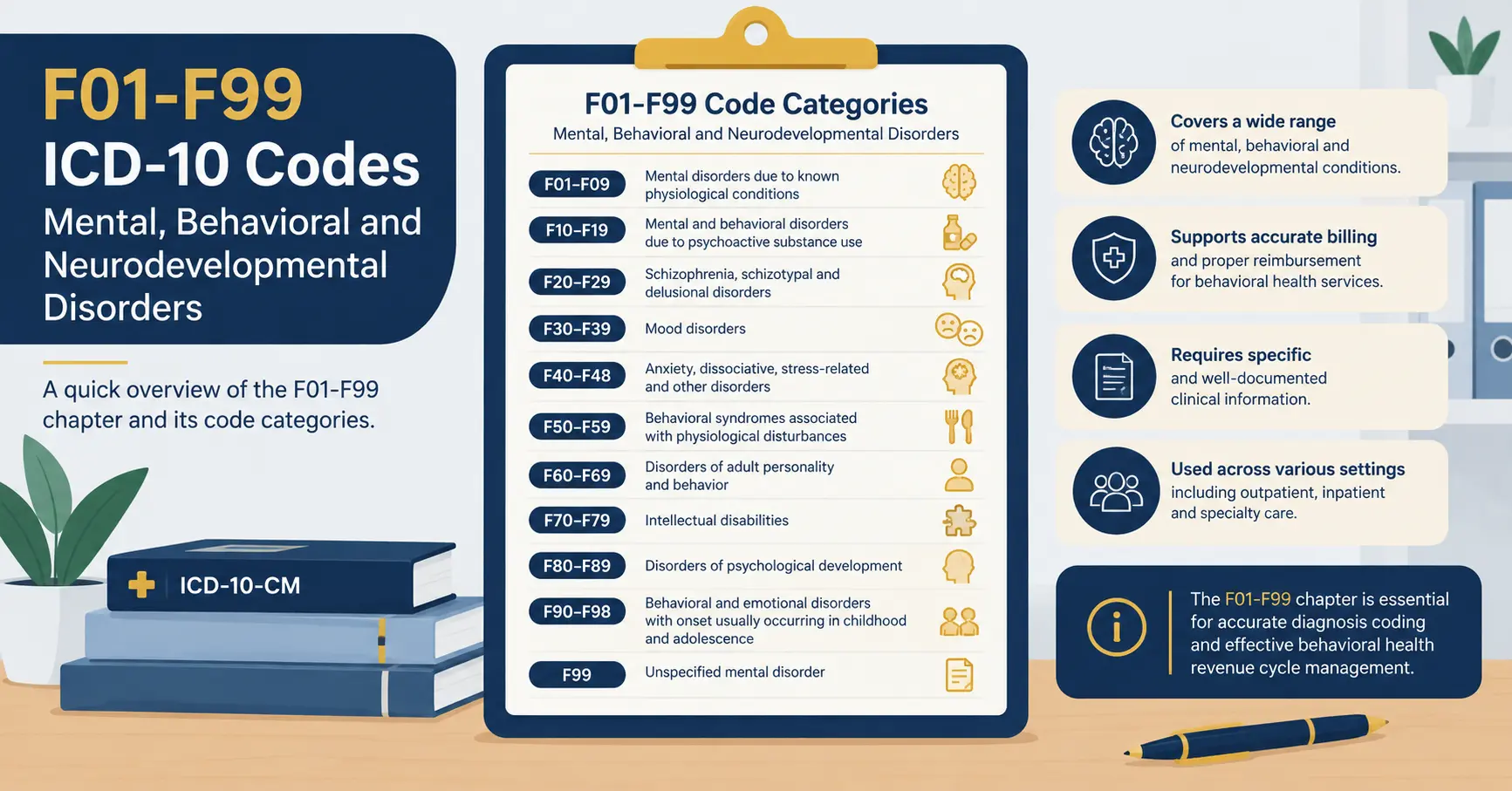
The F01-F99 chapter is organized into category blocks, each covering a related group of conditions. Knowing these blocks at a glance helps a provider or coder quickly locate the right general area before narrowing down to a specific code.
F01-F09: Mental Disorders Due to Known Physiological Conditions
This block covers cognitive and behavioral conditions that have an identifiable medical cause, such as dementia related to Alzheimer's disease, vascular disease, or another underlying condition. These codes are commonly used in combination with the code for the underlying medical diagnosis.
F10-F19: Mental and Behavioral Disorders Due to Psychoactive Substance Use
This block covers disorders tied to the use of alcohol, opioids, cannabis, sedatives, stimulants, hallucinogens, nicotine, and other psychoactive substances. Codes in this range typically specify use, intoxication, withdrawal, or dependence, which is one of the more detailed coding structures in the entire chapter. For example, within the alcohol-related codes alone, a provider has to distinguish between uncomplicated use, use with intoxication, use with withdrawal, and dependence with or without a secondary condition such as alcohol-induced mood disorder. That level of branching is part of why substance use disorder claims see more documentation requests than many other behavioral health claims.
F20-F29: Schizophrenia, Schizotypal, Delusional, and Other Non-Mood Psychotic Disorders
This block includes schizophrenia, schizoaffective disorder, delusional disorder, and brief psychotic disorder. These are conditions centered on disturbances in thinking, perception, or reality orientation rather than primarily on mood.
F30-F39: Mood (Affective) Disorders
This block covers manic episodes, bipolar disorder, major depressive disorder, persistent depressive disorder, and related mood conditions. It is one of the most frequently billed blocks in outpatient and primary care settings.
F40-F48: Anxiety, Dissociative, Stress-Related, Somatoform and Other Nonpsychotic Mental Disorders
This block includes generalized anxiety disorder, panic disorder, obsessive-compulsive disorder, post-traumatic stress disorder, adjustment disorders, and dissociative conditions. It is a frequently used block across nearly every type of outpatient practice.
F50-F59: Behavioral Syndromes Associated With Physiological Disturbances and Physical Factors
This block covers eating disorders, sleep disorders not classified elsewhere, and other conditions where a behavioral pattern is tied to a physiological or physical factor.
F60-F69: Disorders of Adult Personality and Behavior
This block includes personality disorders, impulse control disorders, and gender identity related diagnoses in adults. These are generally long-standing, persistent patterns rather than acute episodes.
F70-F79: Intellectual Disabilities
This block classifies intellectual disability by severity, from mild to profound, based on standardized assessment of intellectual functioning.
F80-F89: Pervasive and Specific Developmental Disorders
This block covers autism spectrum disorder, specific developmental disorders of speech and language, and specific developmental disorders of scholastic skills, along with other developmental conditions affecting a defined area of functioning.
F90-F98: Behavioral and Emotional Disorders With Onset Usually Occurring in Childhood and Adolescence
This block includes ADHD, conduct disorder, oppositional defiant disorder, tic disorders, and several other conditions typically identified in younger patients, though some of these codes can be used at any age when clinically appropriate.
F99: Unspecified Mental Disorder
This single code is reserved for cases where a mental disorder is documented but no further specification is available. It is meant to be used rarely, not as a routine default.

Common Mental Health ICD-10 Codes Providers Search
Within these blocks, a smaller set of codes accounts for most of the day-to-day billing in outpatient and behavioral health practices. The codes below are commonly referenced, but the correct code for any individual patient always depends on the clinical documentation for that encounter, not on this list alone.
Depression
Major depressive disorder falls under F32 for a single episode and F33 for recurrent episodes, with both categories further specified by severity, such as mild, moderate, or severe, and whether psychotic features are present. F34.1 covers dysthymic disorder, now more commonly referred to clinically as persistent depressive disorder.
Anxiety
Generalized anxiety disorder is coded as F41.1. Panic disorder is coded as F41.0. These are two distinct conditions with different diagnostic criteria, and documentation should reflect which one the provider actually assessed and treated.
Bipolar Disorder
Bipolar disorder falls under F31, with subcategories identifying the current episode type, such as hypomanic, manic, depressed, or mixed, and whether psychotic features are present.
ADHD
Attention-deficit hyperactivity disorder is coded under F90, with subcategories for predominantly inattentive type, predominantly hyperactive type, and combined type.
PTSD
Post-traumatic stress disorder is coded under F43.1, with further specification for unspecified, acute, or chronic presentation.
Schizophrenia
Schizophrenia is coded under F20, with subcategories reflecting different clinical presentations of the disorder.
Substance Use Disorders
Substance use disorders fall under F10 through F19, organized by substance class, with further specification for use, intoxication, withdrawal, and dependence. This is one of the more granular sections of the chapter and deserves careful attention to documentation.
Autism and Other Neurodevelopmental Conditions
Autism spectrum disorder is coded under F84, part of the F80-F89 developmental disorders block. Intellectual disability, coded under F70-F79, and other specific developmental disorders also fall within this broader neurodevelopmental category.
Obsessive-Compulsive Disorder
Obsessive-compulsive disorder is coded as F42, with further specification available for predominantly obsessional thoughts, predominantly compulsive acts, or mixed presentation. OCD is sometimes coded inaccurately as a type of anxiety disorder, but it has its own distinct category within the F40-F48 block.
Eating Disorders
Anorexia nervosa and bulimia nervosa fall under F50, part of the behavioral syndromes block. These codes are further specified by subtype, and documentation should reflect the specific eating pattern and any relevant physical findings that support the diagnosis, since eating disorder claims are frequently reviewed closely by payers.
F01-F99 vs. a Specific ICD-10 Diagnosis Code
F01-F99 describes the entire chapter, not a single billable code. Referring to "F01-F99" is a useful shorthand for talking about the mental and behavioral health section of ICD-10-CM as a whole, but no claim should ever be submitted with a range instead of an actual code.
Specificity matters for a few concrete reasons. A specific code supports medical necessity more clearly, because it tells the payer exactly what condition is being treated and at what level of severity. It also supports continuity of care, since a precise diagnosis code carries more useful clinical information forward into the patient's record than a broad or unspecified one. And it reduces the odds of a payer requesting additional documentation, because a well-matched, specific code leaves less room for a reviewer to question whether the service billed was medically necessary.
Choosing between a specified code and a less specific one should always come down to what the documentation actually supports, not convenience. If a provider has documented enough detail to support a more specific code, that code should be used.
Mental Health ICD-10 Coding and Documentation
Accurate F-code assignment depends on documentation that clearly supports the diagnosis selected. A few habits make a consistent difference.
Documentation should state the diagnosis in clinical terms that map directly to an ICD-10-CM code, rather than relying on informal language that a coder has to interpret. Severity, episode type, and relevant modifiers, such as whether a condition is in remission, should be documented when they are clinically known, since these details are often what separates a general code from a more specific one.
The diagnosis should also be clinically supported by the visit itself. A diagnosis carried forward in a chart from a previous visit without current clinical support can create a mismatch between what is billed and what the encounter actually reflects.
Consistency across the record matters as well. When a diagnosis changes or is refined over the course of treatment, the record should reflect that progression clearly, so that a reviewer looking at the chart can follow the clinical reasoning rather than seeing conflicting diagnoses across different notes.
Finally, providers should avoid documenting diagnoses that are not clinically supported, even when a payer's medical necessity criteria seem to favor a particular diagnosis. The diagnosis on the claim should always reflect the provider's actual clinical assessment.
Common F-Code Coding Errors
A handful of recurring mistakes account for much of the rework behavioral health and primary care practices deal with.
Defaulting to Unspecified Codes
Unspecified codes, such as F41.9 for anxiety disorder, unspecified, or F32.9 for major depressive disorder, unspecified, are sometimes used out of habit rather than because the documentation genuinely lacks more detail. When a more specific code is clinically supported, using the unspecified version instead leaves value on the table and can draw more scrutiny from a payer.

Using Outdated Codes
ICD-10-CM is updated annually, and mental health codes are not exempt from those updates. A code that was valid in a prior year's code set may be deleted, replaced, or restructured, and continuing to use an outdated version of a code can result in an automatic denial.
Documentation and Code Mismatch
A code that doesn't align with what is actually written in the note, such as billing a severe episode code when the documentation describes mild symptoms, creates an inconsistency that a payer's review process is likely to flag.
Missing Required Specificity
Several F-code families, including substance use disorders and PTSD, require additional characters to fully specify the condition. Submitting a truncated or incomplete code, when the full code requires more characters, generates a straightforward rejection.
Confusing Clinically Related Diagnoses
Conditions that share overlapping symptoms, such as generalized anxiety disorder and adjustment disorder with anxiety, or major depressive disorder and persistent depressive disorder, are sometimes coded interchangeably when they are, in fact, distinct diagnoses with different criteria. Getting this distinction right depends on the provider's own clinical judgment rather than a coder's assumption.
How Incorrect Mental Health Coding Can Affect Claims
Coding errors in the F01-F99 chapter don't just create extra administrative work. They can directly affect whether a claim gets paid, how quickly it gets paid, and how much follow-up effort it takes to resolve.
Claim denials are the most direct consequence. A code that doesn't support medical necessity for the billed service, or a code that has been deleted or replaced, can result in an outright denial that then has to be corrected and resubmitted.
Payers may also raise medical necessity questions even when a claim isn't outright denied, particularly when an unspecified or general code is used repeatedly for an established patient. This can trigger requests for additional documentation before the claim is finalized.
Incorrect reimbursement is another risk, particularly in behavioral health settings where certain diagnosis and service combinations are tied to specific coverage policies. A mismatched or imprecise code can result in a lower payment than the service actually warranted, or in a payment that later gets reversed on audit.
All of this adds up to claim rework, which is one of the most persistent drains on staff time in behavioral health billing. Every denied or questioned claim has to be investigated, corrected, and resubmitted, and that cycle takes time away from front-end work that could prevent the next denial from happening in the first place.
Prior authorization requirements add another layer in some behavioral health settings, particularly for certain levels of care or extended treatment programs. When the diagnosis code submitted for authorization doesn't match the diagnosis later billed on the claim, payers can flag the discrepancy and delay or deny payment even if the clinical picture is accurate. Keeping the diagnosis consistent from the authorization request through to the final claim is a simple step that prevents an avoidable denial.
Frequently Asked Questions
What are F01-F99 codes?
F01-F99 refers to Chapter 5 of ICD-10-CM, which covers mental, behavioral, and neurodevelopmental disorders. It is not a single code but a range that includes dozens of category blocks and hundreds of specific diagnosis codes.
What does the F code mean in ICD-10?
The letter F designates Chapter 5 of ICD-10-CM. Codes beginning with F are used to document mental, behavioral, and neurodevelopmental conditions, as distinct from codes in other chapters that cover physical conditions, injuries, or other diagnostic categories.
What are common F codes used for mental health?
Commonly used F codes include F32 and F33 for depressive episodes, F41 for anxiety disorders, F31 for bipolar disorder, F43.1 for PTSD, F90 for ADHD, and F20 for schizophrenia. The exact code used depends on the specific diagnosis and the detail available in the clinical documentation.
What is the ICD-10 code for anxiety?
Generalized anxiety disorder is coded as F41.1. Panic disorder is coded as F41.0. Anxiety disorder, unspecified, is coded as F41.9, though a more specific code should be used whenever the documentation supports it.
What is the ICD-10 code for depression?
Major depressive disorder, single episode, is coded under F32, and recurrent major depressive disorder is coded under F33. Both categories are further specified by severity. Persistent depressive disorder, sometimes still referred to as dysthymia, is coded as F34.1.
Are F codes used for behavioral health billing?
Yes. F codes are the diagnosis codes that establish medical necessity for behavioral health services, including psychiatric evaluations, medication management, and psychotherapy. They are also used in primary care and pediatric settings whenever a mental, behavioral, or developmental diagnosis is part of the visit.
Edge RCM CTA
Mental health and behavioral health claims carry their own coding complexity, and small gaps between documentation and code selection tend to show up as denials or payer documentation requests down the line. Edge RCM, based in Reisterstown, works with behavioral health practices and providers who bill F-codes regularly, reviewing claims for documentation alignment, tracking denial patterns tied to coding specificity, and following up on payer requests before they stall reimbursement. Whether your practice is a solo behavioral health provider or a multi-provider group handling a high volume of mental health claims, Edge RCM can help keep coding accuracy and claim follow-up from becoming a bottleneck in your revenue cycle.