Clean Claim Rate: What It Means, How to Calculate It, and How to Improve It
Clean claim rate is the single clearest early indicator of whether a practice's front-end revenue cycle is working. This article covers exactly what the metric measures, how to calculate it, current 2026 industry benchmarks, how it differs from rejection and denial rates, and the specific, practical steps that actually move a low clean claim rate closer to the 95 percent range top-performing practices hit

Introduction
Ask a practice administrator what's wrong with their revenue cycle, and you'll usually hear about denials first. Denials get attention because they're loud, a rejected payment, an appeal letter, a frustrated biller. But by the time a claim is denied, the real problem already happened earlier in the process. Clean claim rate is the metric that catches that problem at the source, before a claim ever reaches a payer's adjudication system.
It's also one of the most useful numbers a practice can track, precisely because it's a leading indicator rather than a lagging one. A denial rate tells you what already went wrong. A clean claim rate tells you how well your front-end process is working right now, which means it's also the metric most directly under your control.
This article covers exactly what clean claim rate measures, how to calculate it, what a good benchmark actually looks like in 2026, and the specific operational changes that move this number in the right direction.
What Is a Clean Claim Rate?
A clean claim is a claim submitted correctly, completely, and in compliance with payer and HIPAA requirements, meaning it can be processed and adjudicated by the payer without needing any correction, additional documentation, or manual intervention. Clean claim rate is simply the percentage of a practice's total submitted claims that meet this bar on the first submission.
It's worth being precise about what this metric does and doesn't capture. Clean claim rate measures whether a claim was accepted for processing cleanly. It doesn't measure whether the claim was ultimately paid at the expected amount, or whether it was later denied for a reason unrelated to the claim's technical completeness, like a medical necessity determination. Those are separate, related metrics covered further below.
Why Clean Claim Rate Matters for Medical Practices
A low clean claim rate isn't just an administrative inconvenience. It has a direct, compounding financial cost.
- Slower cash flow. Every claim that gets kicked back for correction adds days, sometimes weeks, to the time between service delivery and payment, which can ultimately increase a practice's days in A/R.
- Higher cost to collect. Reworking a claim, correcting errors, resubmitting it, and tracking the resubmission all consume valuable staff time and increase the overall cost of collections.
- Increased denial exposure. A claim that isn't clean on the front end has a higher likelihood of eventually being denied outright rather than simply delayed, and a claim that isn't clean on the front end has a higher likelihood of requiring additional follow-up, correction, or resubmission, increasing the risk of delayed or unrecovered revenue.
- Administrative burden that compounds over time. A billing team constantly fighting fires on dirty claims has less capacity to focus on higher-value work like proactive denial prevention or payer contract analysis.
Because clean claim rate reflects the health of your front-end process, front desk, eligibility verification, coding, and claim submission, it's often the fastest metric to actually improve once a practice identifies where the breakdown is happening.
How to Calculate Clean Claim Rate
The formula itself is simple:
Clean Claim Rate = (Number of Clean Claims ÷ Total Claims Submitted) x 100
For example, if a practice submits 1,000 claims in a given period and 920 of them are accepted by the payer on the first submission without requiring correction, the clean claim rate for that period is 92 percent.
What counts as a "clean" claim in this calculation
- The claim was accepted for processing on the first submission
- No additional information, correction, or resubmission was required
- The claim passed through the clearinghouse and payer system without manual intervention
A claim that gets accepted but is later denied during adjudication for a coverage or medical necessity reason is a separate issue from the clean claim calculation itself, since the claim was still processed cleanly on submission. Keeping this distinction clear matters when you're trying to diagnose exactly where a problem in your revenue cycle actually lives.
What Is a Good Clean Claim Rate?
Industry benchmarks from the Healthcare Financial Management Association and MGMA give a fairly consistent picture of what good performance looks like.
- 95 to 98 percent is considered best-in-class performance, the range HFMA specifically recommends as a target for financial stability.
- 90 to 95 percent reflects strong performance, solidly above average but with room to improve.
- 85 to 90 percent is roughly the industry average.
- Below 85 percent signals a structural front-end problem that individual claim-level rework won't fix on its own.
The gap between these tiers is worth taking seriously in financial terms, not just as an abstract score. Moving from a 90 percent clean claim rate to 98 percent on a base of 500 monthly claims eliminates roughly 40 dirty claims a month. At an estimated $103 in rework cost per dirty claim, that's more than $4,000 a month recovered before you even factor in the downstream denial rate improvement that typically comes with it.
Clean Claim Rate vs. Claim Rejection Rate vs. Denial Rate
These three terms get used interchangeably in casual conversation, but they measure different points in the claims process, and confusing them makes it much harder to diagnose where your practice's actual problem is.
Clean claim rate
Measures whether a claim was submitted correctly and completely enough to be processed without correction on the first attempt. This is the earliest checkpoint in the sequence.
Claim rejection rate
Reflects claims that are kicked back before they ever reach payer adjudication, typically caught by the clearinghouse due to formatting errors, invalid member IDs, or missing required fields. A rejected claim never actually entered the payer's review process at all.
Denial rate
Reflects claims that were accepted and adjudicated by the payer, but payment was refused or reduced for a substantive reason, medical necessity, lack of prior authorization, coverage limitations, or timely filing issues. According to MGMA, the average initial claim denial rate across U.S. medical practices reached 11.8 percent in 2024, up from 10.2 percent a few years earlier, and separate survey data from Experian Health found 41 percent of providers now report denial rates of 10 percent or higher.
A practice can have a high clean claim rate and still struggle with denials, since those are governed by different rules, coverage determinations and medical necessity versus technical completeness. Understanding the most common causes of claim denials can help practices identify which problems need to be addressed after a claim reaches the payer. Tracking all three metrics separately is the only way to know which part of the revenue cycle actually needs attention.
What Causes a Low Clean Claim Rate?
Most root causes cluster into a small number of categories, and understanding which category is driving your practice's numbers determines where to focus improvement efforts.
- Front-end registration errors. Incorrect insurance information, subscriber ID typos, and demographic mismatches, almost always originating before the clinical encounter even happens.
- Coding errors. Incorrect or outdated CPT and ICD-10 codes, missing modifiers, and National Correct Coding Initiative edit failures.
- Documentation gaps. Insufficient clinical notes, missing physician signatures, or documentation that doesn't clearly support the billed service.
- Payer-specific formatting issues. Missing prior authorization numbers, incorrect place of service codes, or field-level formatting requirements specific to an individual payer.
Front-end registration errors tend to account for the largest share of dirty claims industry-wide, since they happen before the clinical encounter even starts and aren't caught by coding-level quality checks further downstream.
10 Common Reasons Medical Claims Fail to Process Cleanly
- Inactive insurance coverage on the date of service that wasn't verified beforehand
- Incorrect or mistyped subscriber ID or group number
- Patient demographic information that doesn't match what the payer has on file
- Missing or expired prior authorization for a service that required it
- Outdated CPT or ICD-10 codes that fail payer edit checks
- Missing or incorrect modifiers on bundled or multiple procedures
- Incomplete or missing documentation supporting medical necessity
- Coordination of benefits errors, where the claim was sent to the wrong payer as primary
- Incorrect place of service or provider information on the claim
- Claims submitted after a payer's specific filing deadline
How Medical Practices Can Improve Their Clean Claim Rate
Improvement here comes from tightening specific points in the workflow, not from a single sweeping fix.
Verify Patient Eligibility
Confirm active coverage and benefit details before the visit, not at check-in and definitely not after the claim is already prepared. Verifying eligibility at the point of scheduling, rather than waiting until the day of service, gives staff more time to resolve coverage issues before they turn into claim rejections or denials.
Improve Documentation and Coding Accuracy
Build coding validation into the workflow itself, using current code sets and confirming that documentation clearly supports the specific service and level billed, rather than relying solely on after-the-fact audits to catch mismatches.
Verify Prior Authorization Requirements
Confirm authorization status, and that the authorized code matches the service actually performed, before the date of service. A mismatched or expired authorization is one of the more preventable causes of a dirty claim.
Check Provider and Payer Information
Confirm provider NPI, taxonomy, and enrollment status are current and correctly reflected on the claim, along with accurate payer-specific identifiers, since a mismatch here can trigger rejection even when every other part of the claim is correct.
Use Claim Scrubbing
Claim scrubbing is the automated review of a claim against payer rules, coding standards, and eligibility requirements before it's transmitted. Top-performing practices run every claim through a scrubber before submission, catching modifier conflicts, bundling violations, and missing fields before they ever become a rejection or denial.
Review Claims Before Submission
Even with automated scrubbing in place, a final human review step for higher-complexity or higher-dollar claims catches issues automated tools may miss, particularly around documentation quality and medical necessity language.
How to Monitor and Track Clean Claim Rate
- Calculate clean claim rate on a consistent, recurring basis, monthly at minimum, rather than only checking it when cash flow already feels tight.
- Break the metric down by payer, since a low overall rate often traces back to a specific payer with more demanding formatting or documentation requirements.
- Track it alongside, but separately from, rejection rate and denial rate, so you can see clearly which stage of the process is driving problems.
- Segment by provider or department where practice size allows, since a pattern concentrated in one area often points to a specific, fixable process gap.
- Set a specific target benchmark, ideally in the 95 percent range, and review progress against it on a regular cadence rather than tracking the number without a goal attached to it.
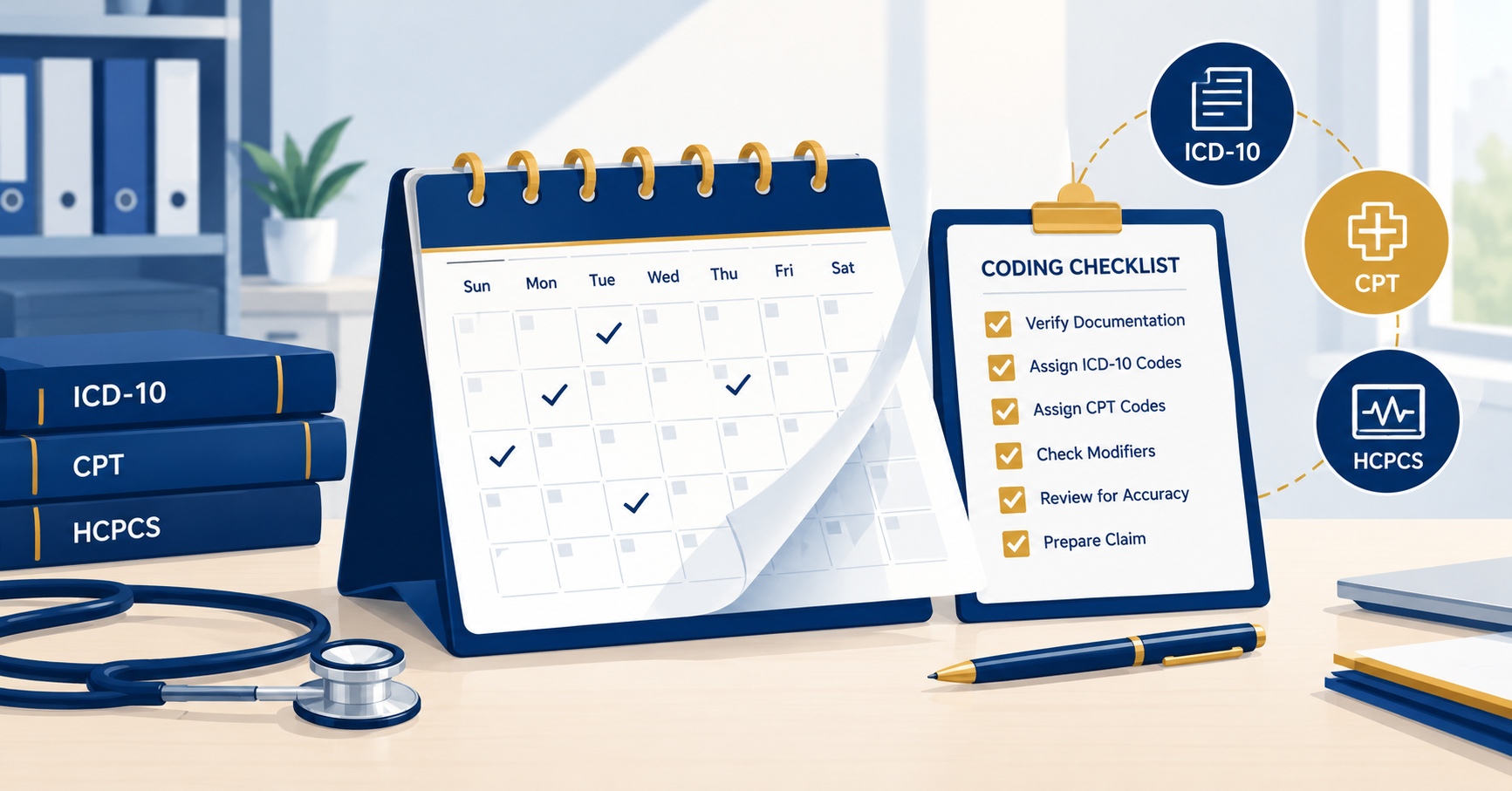
Clean Claim Rate Checklist for Medical Practices
- Insurance eligibility verified before the date of service, ideally at scheduling
- Patient demographic information matches current payer records
- Prior authorization confirmed and matched to the exact service being billed
- CPT and ICD-10 codes current and correctly paired with clear documentation support
- Required modifiers applied correctly for bundled or multiple procedures
- Claim run through an automated scrubber before submission
- Provider and payer identifiers confirmed accurate on the claim
- Claim submitted within the specific payer's filing deadline
When Should a Practice Consider Outsourcing RCM?
Outsourcing isn't the right move for every practice, but a few signals suggest it's worth seriously evaluating a professional revenue cycle management service.
- Clean claim rate has been stuck below 90 percent despite internal efforts to address it, suggesting the underlying process issues need more dedicated expertise than current staff capacity allows.
- Billing staff turnover keeps resetting institutional knowledge around payer-specific requirements and internal workflow fixes.
- The practice is growing faster than its administrative capacity, and claim volume is outpacing the team's ability to review and scrub claims thoroughly before submission.
- Leadership lacks clear, regular visibility into clean claim rate, rejection rate, and denial rate as separate, tracked metrics.
- The practice is spending more time on claim rework than on proactive process improvement, a sign the team is permanently stuck reacting rather than preventing.
Conclusion
Clean claim rate is one of the few revenue cycle metrics that tells you exactly where to look when something's wrong, and gives you real room to fix it before it turns into a denial or a cash flow problem. The practices sitting in the 95 to 98 percent range didn't get there by accident. They built eligibility verification, coding accuracy, and claim scrubbing directly into their workflow, and they track the number consistently enough to catch a slipping trend before it becomes a quarter-long problem. Whether your practice handles this internally or brings in outside support, the path to a stronger clean claim rate runs through the same handful of front-end checkpoints every time.