
Radiology Coding and Billing: CPT Codes, CMS Guidelines, and Common Errors
Radiology coding accuracy directly determines reimbursement, and the specialty carries more coding complexity than most, contrast status, view counts, component billing, and setting-specific code selection all affect whether a claim gets paid correctly. This guide covers how radiology coding works, common CPT codes by modality, CMS guidelines, documentation requirements, and the errors that most often cost Maryland imaging practices revenue.
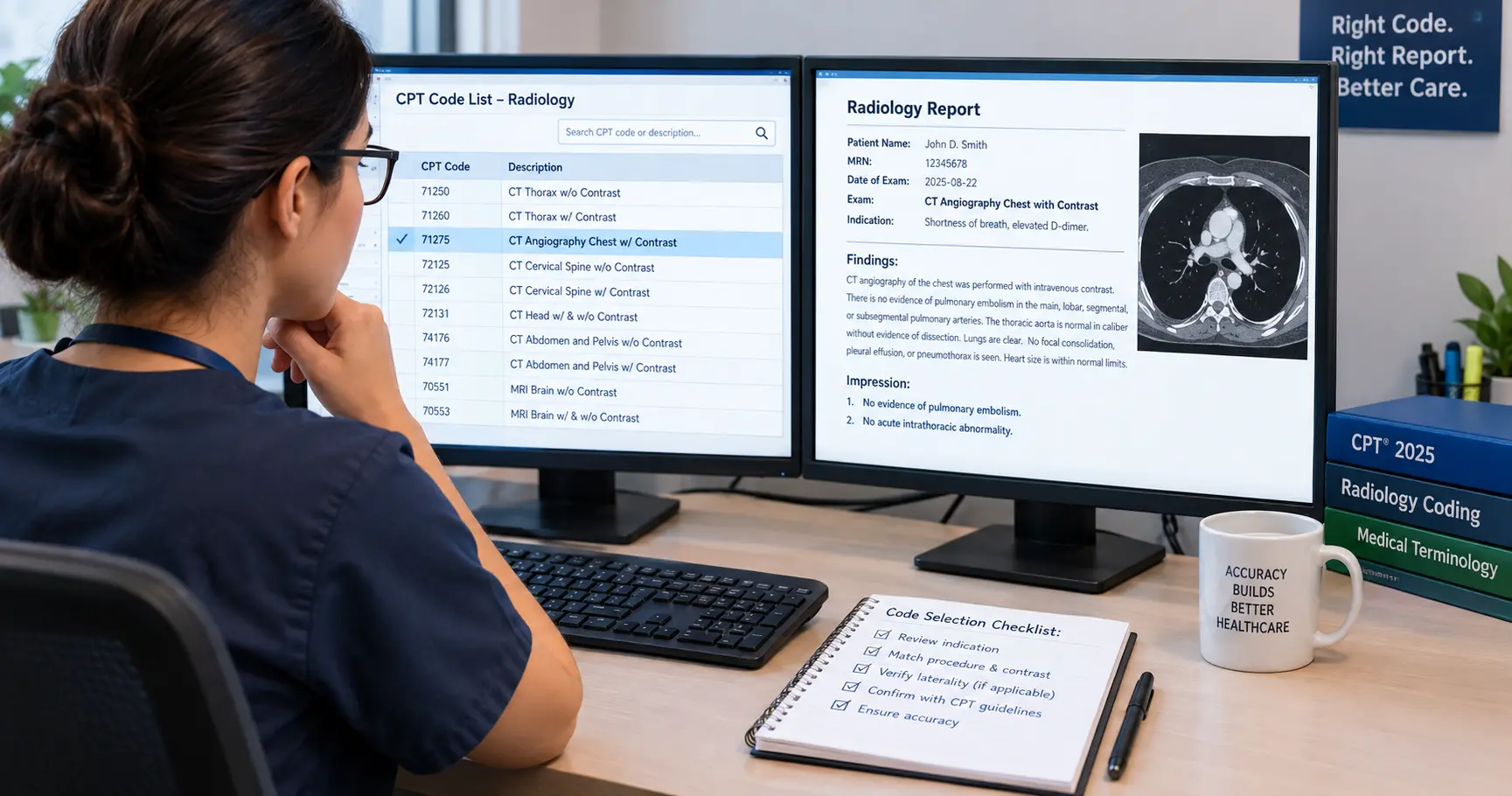
Radiology coding and billing carries more structural complexity than most specialties, and it shows in the denial data. Contrast status, view counts, anatomical specificity, and component billing all affect which CPT code actually applies to a given study, and getting any one of these details wrong translates directly into delayed or denied reimbursement.
For radiology practices and imaging centers across Maryland, from hospital-based groups in Baltimore to independent centers in Rockville, Columbia, and Frederick, understanding this coding structure isn't optional detail work. It's the foundation that determines whether accurate clinical imaging actually converts into accurate, collected revenue. This guide walks through how radiology coding works, the CPT codes practices bill most often, CMS guidelines, and the specific errors that cause the most avoidable denials.
What Is Radiology Coding and Billing?
Radiology coding and billing is the process of translating an imaging study, and the radiologist's interpretation of it, into the specific CPT and HCPCS codes that describe exactly what was performed, then submitting that information to a payer for reimbursement. The radiology section of the CPT code set spans 70010 through 79999, covering diagnostic imaging, image-guided procedures, radiation oncology treatments, mammography, ultrasound, and nuclear medicine.
Accurate coding depends on several distinct pieces of information matching each other consistently: the anatomical site imaged, whether contrast was used, how many views or sequences were performed, and, for many services, whether the claim reflects the professional component, technical component, or a global service.
How Radiology Coding Works
Radiology code selection depends on several variables working together, not any single detail in isolation.
- Modality, since X-ray, CT, MRI, ultrasound, and nuclear medicine each carry entirely separate code families.
- Body region, since head, chest, spine, abdomen, pelvis, and extremity studies carry distinct codes even within the same modality.
- Contrast status, since most CT and MRI studies split into three codes: without contrast, with contrast, and without followed by with contrast in the same session.
- Number of views, particularly relevant for plain film X-ray, where the report needs to document every view actually billed.
- Guidance method, since fluoroscopic, CT, MRI, and ultrasound guidance each carry different codes, and many bundle directly into the primary procedure rather than billing separately.
One rule sits above all of these variables: the report governs code selection, not the original order. If an order specifies a non-contrast study but the radiologist's documentation confirms contrast was actually administered, the code needs to reflect what the report describes, not what was originally ordered.
Common Radiology CPT Codes
X-ray
- 71045: Chest X-ray, single view
- 71046: Chest X-ray, two views, among the most frequently billed codes in radiology
- 71048: Chest X-ray, four or more views
- 72100: Spine, lumbosacral, two or three views
- 73560: Knee, two views
CT
- 70450: CT head, without contrast, one of the most frequently billed CT codes
- 70460: CT head, with contrast only
- 70470: CT head, without contrast followed by with contrast in the same session
- 74176, 74177, 74178: CT abdomen and pelvis without contrast, with contrast, and without followed by with contrast respectively, with 74177 alone appearing in roughly 1.9 percent of all radiology billing in 2023
- 71250, 71260, 71270: CT thorax without, with, and without followed by with contrast
MRI
- 70551, 70552, 70553: MRI brain without, with, and without followed by with contrast, with 70553 among the most frequently billed
- 72148, 72149, 72158: MRI lumbar spine without, with, and without followed by with contrast
Ultrasound
- 76700: Abdominal ultrasound, complete
- 76705: Abdominal ultrasound, limited
- 76856: Pelvic ultrasound, complete
These represent a small fraction of the full radiology code set, but a small group of high-volume procedures, chest X-rays, lumbar spine imaging, abdominal and pelvic CT, and abdominal ultrasound, accounts for the majority of claim volume at most imaging centers and practices across Maryland.
Professional vs. Technical Component
Most radiology CPT codes split into a technical component, covering equipment, staffing, and facility costs, and a professional component, covering the radiologist's interpretation and signed report, billed with modifier TC and modifier 26 respectively. When one entity provides both, the service is billed globally with no modifier.
This distinction affects nearly every code listed above, and getting it right depends on understanding exactly who owns the equipment and who performed the interpretation for each specific study. Rather than repeat that detail here, our dedicated guide on Modifier 26 vs. TC in Radiology Billing covers the full mechanics, common mistakes, and real billing scenarios in depth.
CMS Radiology Billing Guidelines
Medicare and most commercial payers reimburse radiology services based on the Resource-Based Relative Value Scale, which assigns each CPT code a specific relative value reflecting physician work, practice expense, and malpractice cost components. CMS updates the CPT code set annually, effective every January 1, and the 2026 update alone introduced 418 total changes across all specialties, including 288 new codes, 84 deletions, and 46 revisions, with radiology specifically gaining a combined CT angiography head and neck code and new CT cerebral perfusion codes.
Deleted codes deny automatically starting with the first claim of the new year if they're still sitting in a practice's chargemaster, order sets, or EHR templates from the prior year, making an annual code set review a genuine compliance necessity, not an optional housekeeping task. CMS also applies setting-specific coding rules for certain studies. Bilateral breast MRI without contrast, for example, uses CPT 77047 when billed by a physician office or freestanding imaging center, but HCPCS code C8908 when billed by a hospital outpatient department under the Medicare Outpatient Prospective Payment System, and using the wrong code for the billing setting is a well-documented, common source of denial.

Radiology Coding and Documentation Requirements
Documentation needs to support every element the code reflects. Only intravenous contrast qualifies a study for a with-contrast code, oral or rectal contrast, common in many abdominal CT protocols, does not change the code, and billing a with-contrast code based on oral-only contrast administration is a documented upcoding finding in imaging audits.
MRI interpretation specifically requires a signed, narrative radiology report. Template-generated reports without individualized findings specific to the study performed are a documented audit target for Medicare Recovery Audit Contractors, since a generic template doesn't demonstrate that genuine, study-specific interpretation actually occurred.
Common Radiology Coding Errors
- Contrast misclassification, billing a with-contrast code when only oral or rectal contrast was administered, or missing a contrast code entirely when IV contrast was actually given.
- Component billing errors, incorrect use of modifier TC, modifier 26, or global billing relative to the practice's actual ownership and interpretation arrangement.
- Bundling violations, billing a guidance code separately when it should bundle into the primary procedure, or billing CT colonography alongside a same-day diagnostic colonoscopy, which National Correct Coding Initiative edits specifically bundle together.
- Incomplete documentation, particularly template-generated reports lacking individualized findings, or missing view counts on plain film studies.
- Wrong code for the billing setting, using a physician-office code when the service was actually performed in a hospital outpatient department, or vice versa.
- Working from the order instead of the report, coding based on what was originally requested rather than what the radiologist's documentation actually confirms was performed.

How Coding Errors Affect Claims and Reimbursement
Coding errors don't produce a uniform outcome. Some result in outright denial, a bundled code billed separately, or a deleted code still sitting in a template. Others result in underpayment that's harder to catch, a with-contrast study coded without contrast, quietly billing at a lower rate than the service actually warranted. Setting-specific coding errors can trigger payer audits, since a mismatched code for the billing location is a well-recognized red flag in claims review systems.
Practices operating across multiple Maryland locations, from Bethesda to Salisbury, face a particular version of this risk when coding staff apply the same default code choices across sites with different ownership, employment, or facility-type arrangements without adjusting for each location's specific structure. Radiology practices are also increasingly evaluating how AI affects reimbursement, coding workflows, and payment for AI-assisted imaging services.
Radiology Billing Workflow
A dependable radiology billing workflow moves through the same core stages every time: confirming the anatomical site and contrast status against the actual radiology report, verifying the correct component billing scenario for the specific study, checking the code against current-year CPT updates and any relevant NCCI bundling edits, confirming the code matches the billing setting, and reviewing documentation completeness before submission rather than after a denial arrives. Practices in Annapolis, Glen Burnie, or anywhere else in Maryland benefit from applying this workflow consistently across every location and every coder, rather than allowing informal, site-specific shortcuts to develop over time.
How Practices Can Improve Coding and Billing Accuracy
- Review chargemasters, order sets, and EHR templates against the current CPT code set every January, removing deleted codes before they generate automatic denials.
- Build coding checks that verify contrast status against the actual radiology report, not just the original order.
- Confirm setting-specific code requirements for services with distinct physician-office and hospital-outpatient codes.
- Require individualized, narrative interpretation reports rather than relying on unedited templates.
- Track denials by specific error category, contrast misclassification, component billing, bundling, to identify recurring workflow gaps rather than correcting each claim in isolation.
- Standardize coding review processes across every practice location rather than allowing site-by-site variation.
- Practices should also keep provider credentialing and enrollment information current so billing data remains aligned with payer records.
Frequently Asked Questions
What CPT code range covers radiology services?
The radiology section of the CPT code set spans 70010 through 79999, covering diagnostic imaging, image-guided procedures, radiation oncology, mammography, ultrasound, and nuclear medicine.
What determines which radiology CPT code applies to a study?
Modality, body region, contrast status, number of views, and guidance method all determine the specific code, with the radiologist's actual report governing code selection rather than the original order.
Does oral contrast qualify a study for a with-contrast CPT code?
No. Only intravenous contrast qualifies a study for a with-contrast code. Oral or rectal contrast does not change code selection, and billing a with-contrast code based only on oral contrast is a documented upcoding finding in imaging audits.
Why do CPT codes sometimes differ by billing setting for the same procedure?
Some services carry separate codes depending on where they're billed, a physician office or freestanding imaging center code versus a hospital outpatient department code under Medicare's Outpatient Prospective Payment System, and using the wrong code for the actual setting is a common cause of denial.
What documentation does MRI interpretation require?
A signed, narrative radiology report with individualized findings specific to the study performed. Template-generated reports without that specificity are a documented audit target for Medicare Recovery Audit Contractors.
How often does the CPT code set change for radiology?
The American Medical Association publishes an updated CPT code set every January 1. The 2026 update introduced 418 total changes across specialties, including new radiology-specific codes for CT angiography and cerebral perfusion imaging.
Conclusion
Radiology coding accuracy depends on details that are easy to overlook individually but that compound quickly across a practice's full claim volume, contrast status, view counts, component billing, and setting-specific code selection all have to align correctly with what the radiologist actually documented. For imaging practices across Maryland, from Baltimore's hospital-based groups to independent centers in Frederick, Columbia, and beyond, building coding workflows around these specific, well-documented risk points is what protects reimbursement for the clinical work already being performed accurately.
Edge RCM CTA
Radiology coding carries more structural complexity than most specialties, and even small, recurring errors in contrast classification, component billing, or setting-specific code selection can quietly cost a practice real revenue. Edge RCM, based in Reisterstown, supports radiology practices and imaging centers across Maryland with coding accuracy review, claims management, and denial prevention built specifically around radiology's coding structure.