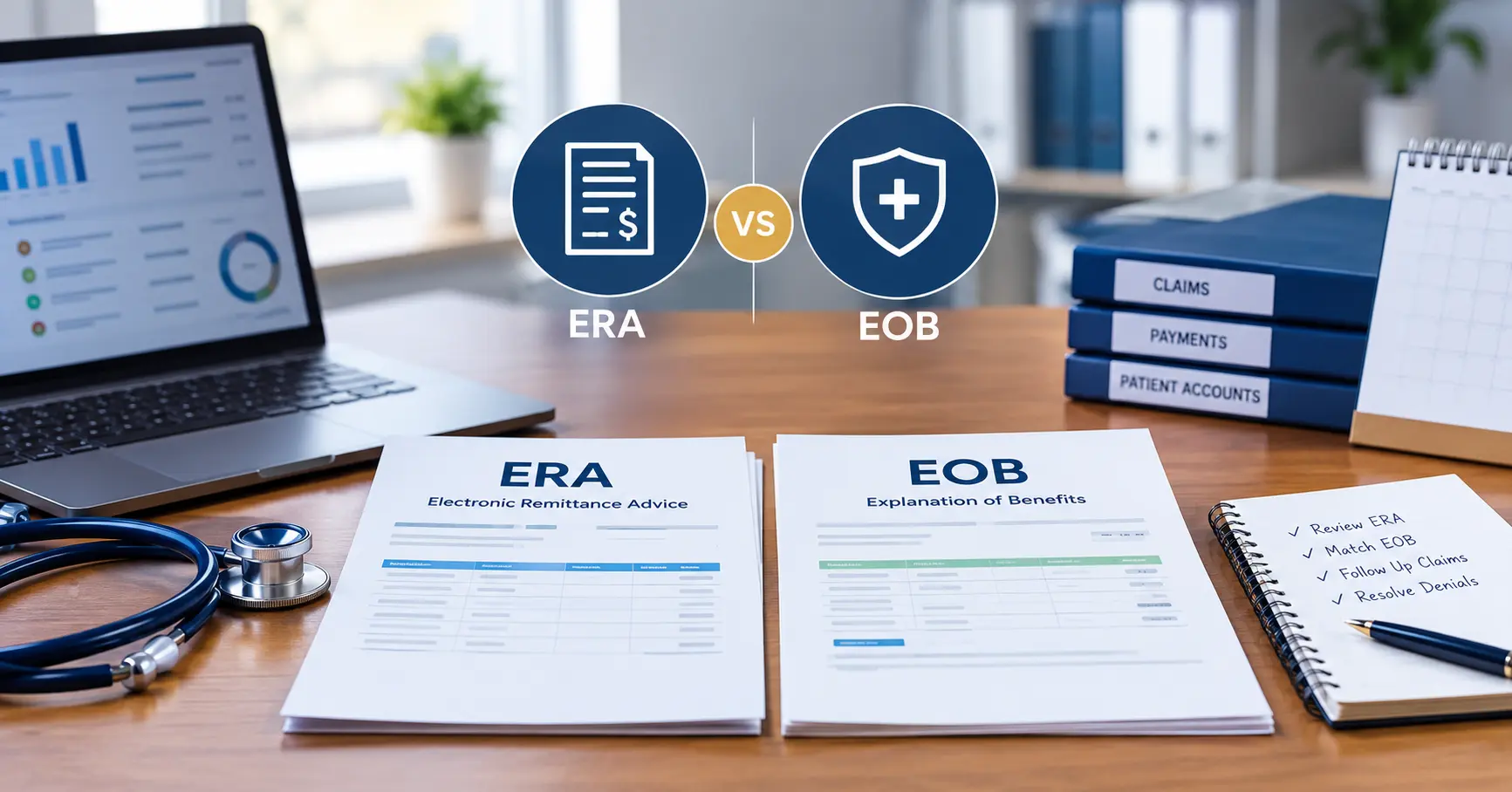
ERA vs EOB in Medical Billing: What Practices Need to Know
ERA and EOB both describe the same payer decision on a claim, but they are built for different readers. This guide breaks down ERA vs EOB in medical billing, including how to read each document, common CARC and RARC codes, and how the two documents support payment posting, denial management, and patient communication.
Electronic Remittance Advice (ERA) vs. Explanation of Benefits (EOB): What Medical Practices Need to Know
Introduction: ERA vs EOB in Medical Billing
A patient arrives at the front desk holding an insurance notice and asks why it shows a balance. At the same moment, the billing team is working from a different document, a remittance file, to post payment for the same claim. Both documents describe one payer decision, yet they are written for different readers, and practices still use "ERA" and "EOB" interchangeably. That confusion is the core problem behind ERA vs EOB in medical billing.
Before electronic remittance became common, billing staff often matched paper checks and remittance statements to patient data by hand. Today, an ASC X12 835 file typically moves from the payer through a clearinghouse or portal into billing software, while the member receives an informational summary by mail or online. Knowing which document answers which question keeps payment posting, denial management, and patient communication on track.
Quick answer: An ERA (electronic remittance advice) is the provider-facing electronic file that reports how a payer paid, adjusted, or denied a claim, usually in the ANSI X12 835 format. An EOB (explanation of benefits) is the member-facing notice that explains how a health plan processed a claim and what the member may owe. "Remittance advice" (RA) is the broader term for a payer's payment explanation to a provider, in electronic or paper form.
What Is an ERA in Medical Billing?
Electronic remittance advice (ERA) is a payer's electronic explanation of payment to a healthcare provider. For each claim, and often each service line, it reports what the payer paid, what it adjusted, and why. In the United States, the adopted standard format is the ASC X12N 835 Health Care Claim Payment/Advice transaction, which HHS adopted under HIPAA (CMS: Adopted Standards and Operating Rules). Because an 835 is structured data rather than a letter, billing software can read it and match its contents to the claims sitting in accounts receivable.
A typical ERA includes the payment amount, claim adjustments such as contractual adjustments and write-offs, amounts assigned to patient responsibility, and denials. Each adjustment carries a group code and a claim adjustment reason code (CARC), and remittance advice remark codes (RARCs) can add detail. The file also identifies the payment method and a trace number, which helps staff match the remittance to an electronic funds transfer (EFT) or check. Some adjustments apply to the provider rather than a single claim, such as an overpayment recovery, and these appear in a separate provider-level section of the 835.
An ERA does not always include a payment. A claim that is denied, or one that is applied entirely to the patient's deductible, can produce a remittance line with a zero payment. The claim status and the adjustment codes matter as much as the dollar amount, so staff should read them before treating a zero-pay line as an error.
An ERA reaches a practice through a payer's electronic connection, usually via a clearinghouse, a payer portal, or a billing platform. Payers typically require enrollment before they send ERAs, so a practice that has not completed it may keep receiving paper remittance advice, sometimes informally called a paper EOB. Paper remittance carries similar payment information but is not an 835 file.
Several organizations shape this ecosystem. HHS adopts the HIPAA transaction standards, and CMS publishes guidance on them. The ASC X12N committee develops the 835 itself. The American Medical Association (AMA) publishes CPT, the code set used to identify physician services on claims and remittance detail.
Automated payment posting is a common goal, but it is not guaranteed. It depends on payer enrollment, software configuration, EDI connectivity, and successful matching of each ERA line to a claim. Exceptions, unmatched payments, and denials still need staff review, and manual data entry remains necessary when a file cannot be posted automatically.
What Is an EOB in Medical Billing?
An explanation of benefits (EOB) is a notice from a health plan to its member after a claim is processed. It summarizes the services billed, the amount the plan allowed, what the plan paid, and what the member may owe through a deductible, copay, or coinsurance. It is written in plain language for someone without billing training. Layouts vary by insurer, and the document usually explains how to appeal a decision.
An EOB is not a bill. Medicare's notices say so on the first page, and the same principle applies to most insurer EOBs (Washington Office of the Insurance Commissioner: Medicare statements teaching materials). The provider sends the actual statement, and patients should compare the two before paying. Names differ across programs: Original Medicare beneficiaries receive a Medicare Summary Notice, while Medicare Advantage and Part D enrollees receive EOBs.
Patients benefit from the EOB in several ways. It explains where the money went, helps them understand out-of-pocket costs, and lets them confirm that the listed services match the care they received, which can help surface billing errors or fraud. It also gives the patient the information needed to dispute a decision. When a patient has more than one plan, EOBs support coordination of benefits by showing how the primary plan processed the claim.
EOBs may list CPT codes or service descriptions, but patients rarely know what those codes mean. Billing staff can help by explaining that the document reports the insurer's decision and that the practice's own statement shows the balance actually due.
Illustrative EOB example: The amounts below are consistent with one another and show how patient responsibility is built. Plan designs differ, and a copay, if the plan applies one, would appear as its own line.
| EOB line | Amount |
| Billed amount | $4,000.00 |
| Plan discount | $800.00 |
| Allowed amount | $3,200.00 |
| Applied to deductible | $1,500.00 |
| Coinsurance (20% of the remaining $1,700.00) | $340.00 |
| Plan paid | $1,360.00 |
| Patient responsibility (deductible plus coinsurance) | $1,840.00 |
The allowed amount of $3,200.00 equals the plan payment of $1,360.00 plus the patient responsibility of $1,840.00.
ERA vs. EOB: Key Differences
The key takeaway is that both documents reflect the same claim adjudication, but they serve different users. The ERA supports the provider's accounting and follow-up work. The EOB supports the member's understanding and rights.
| Feature | ERA | EOB |
| Primary recipient | Provider or billing company | Patient or policyholder |
| Sent by | Payer, usually through a clearinghouse or portal | Health plan or insurer |
| Main purpose | Payment posting, adjustment review, denial follow-up | Explaining how benefits were applied and what the patient may owe |
| Typical format | Electronic ASC X12 835 file | Paper, PDF, or online portal; layout varies by plan |
| Detail level | Claim and service-line adjustments with group codes, CARCs, and RARCs | Plain-language summary of services, amounts, and patient costs |
| Is it a bill? | No, it is a payment explanation | No, it is an informational summary |
| Staff action | Post payments, review adjustments, work denials | Compare with the provider statement; follow the appeal instructions if the decision looks wrong |
Audience, Purpose, and Intent
The payer sends both documents, but the intent differs. An ERA tells the provider what the payer decided and how the payment was calculated, so staff can post and follow up. An EOB tells the member how benefits were applied. Medicare illustrates how labels blur: providers receive remittance advice, either electronic or on a standard paper remittance, while beneficiaries receive a Medicare Summary Notice or an EOB. Staff should avoid calling every payer document an EOB.
Format and Delivery
The ERA is a data file intended for software. The EOB is a readable document delivered on paper, as a PDF, or through a member portal, depending on the plan. Medicare's Standard Paper Remittance (SPR) is a separate case. It is a paper format described in the same CMS manual chapter that covers the ERA, and CMS notes that some institutional remittances report claim-level summary information rather than service-line adjustment data (CMS Medicare Claims Processing Manual, Chapter 22). Line-level detail therefore depends on the claim type and the remittance format, so staff should confirm what their contractor sends.
Timing
No single timeline applies to every payer, claim, or delivery method. An EOB may reach a patient before or after the provider's statement, and an ERA may arrive before or after the EOB. Practices should avoid assuming an order and should tell patients early that an insurer notice may arrive first.
ERA, EOB, and Remittance Advice
Remittance advice is the general term for a payer's explanation of payment to a provider. An ERA is the electronic version, delivered as an 835. A paper remittance advice carries similar information in a non-835 format. An EOB is a separate document for the member, not a version of the remittance advice. Keeping the three terms distinct prevents mistakes in posting, patient communication, and payer follow-up.
ERA vs. EOB: A Side-by-Side Example
This example is illustrative and does not come from a real claim. A patient has an office visit and a blood panel. The provider bills $320.00. The payer's contracted fee schedule allows $210.00, and the patient has not met the deductible.
| Claim detail | ERA (billing team view) | EOB (patient view) |
| Service | Office visit and blood panel | Office visit and blood panel |
| Billed amount | $320.00 | $320.00 |
| Contractual adjustment | $110.00, group code CO, reason code 45 | Plan discount: $110.00 |
| Allowed amount | $210.00 | $210.00 |
| Deductible | $100.00, group code PR, reason code 1 | Applied to your deductible: $100.00 |
| Payer payment | $110.00 | Plan paid: $110.00 |
| Patient responsibility | $100.00 | Amount you may owe: $100.00 |
The arithmetic reconciles: $320.00 billed minus the $110.00 contractual adjustment equals the $210.00 allowed amount, and the allowed amount minus the $100.00 deductible equals the $110.00 payment.
For the billing team, CO-45 is posted as a contractual write-off, the $110.00 payment is posted to the claim, and the $100.00 PR-1 amount moves to patient responsibility. The CO-45 amount is an adjustment rather than a denial. The patient's EOB tells the same story in plain language, and the patient should wait for the provider's statement before paying.
How to Read an ERA
Reading an ERA accurately determines whether payment posting and patient statements are correct. A practical review sequence is:
- Confirm identifiers. Check that the payer, payee, NPI, and patient control or claim number match a claim your practice submitted.
- Compare the amounts. Review billed, allowed, and paid amounts for each claim and service line.
- Read the group code first. CO generally means the provider absorbs the amount, PR means it is patient responsibility, and OA means other adjustment.
- Read the CARC, then the RARCs. The reason code explains the adjustment, and remark codes add detail.
- Identify patient responsibility. PR-1, PR-2, and PR-3 represent deductible, coinsurance, and copayment amounts, which feed patient statements.
- Check zero-payment lines. A zero payment may be a denial, a bundling adjustment, or an amount applied entirely to patient responsibility.
- Review provider-level adjustments. Overpayment recoveries and similar items affect the total payment.
- Match the remittance to the payment. Compare the total to the EFT or check and the bank deposit.
Adjustment interpretation depends on the full code combination, the claim circumstances, and payer rules, so unfamiliar codes should be checked against the current official lists.
How to Read an EOB
Patients can use a simple checklist, and staff can walk them through it:
- Confirm the details. Check the service dates, descriptions, and provider names against the care received. Unexplained items may signal a billing error or fraud.
- Find the amounts. Look for the plan paid amount and the amount the patient may owe, often labeled patient responsibility.
- Check the deductible. Note how much was applied to the deductible and how much remains.
- Do not pay from the EOB alone. Wait for the provider's statement, then compare it with the EOB.
- Use the appeal information. If the claim appears to have been processed incorrectly, follow the instructions printed on the notice and watch the stated deadline.
Common CARC and RARC Codes
A group code and a reason code work together. The group code assigns financial responsibility, the CARC explains the reason for the adjustment, and RARCs supply additional detail. The same reason code can appear with different group codes, so staff should read the complete combination. The official lists are maintained by X12 (CARC list and group codes).
| Code | Meaning (X12 wording, shortened) | Practical note |
| CO-45 | Charge exceeds fee schedule, maximum allowable, or contracted fee arrangement | Usually a contractual write-off, not a denial |
| PR-1 | Deductible amount | Patient responsibility |
| PR-2 | Coinsurance amount | Patient responsibility |
| PR-3 | Co-payment amount | Patient responsibility |
| CO-97 | Benefit for this service is included in the payment or allowance for another service already adjudicated | Often called bundling; review before treating it as a denial |
| CO-4 | Procedure code is inconsistent with the modifier used, or a required modifier is missing | Review modifier use, then consider a corrected claim |
| CO-96 | Non-covered charge(s) | Review plan coverage and any required remark codes |
| CO-50 | Non-covered services because this is not deemed a "medical necessity" by the payer | Review documentation and appeal options |
| OA-23 | Impact of prior payer adjudication, including payments or adjustments | Appears with group code OA; common in coordination of benefits |
The code "WO" is different. It is a provider-level adjustment code in the 835's provider-level balance (PLB) segment that identifies an overpayment recovery, not a claim-level CARC (UnitedHealthcare EDI 835 provider-level adjustments).
It also helps to separate four ideas. A denial means a service was not paid. A payment adjustment means the payer paid a different amount than billed. A contractual write-off is an amount the provider may not collect from the patient under the payer contract. Patient responsibility is the portion the patient may owe. Whether a particular amount can be billed to the patient depends on the group code, the contract, and payer or program rules. For Medicare, a beneficiary generally may be billed only for amounts adjusted with PR (BehaveHealth: CARC codes explained).
How ERA Supports Payment Posting and Financial Reconciliation
Financial reconciliation ties together three records: the claim submitted, the remittance received, and the money deposited. An ERA makes this practical because it reports each claim's payment and adjustments in a consistent format and carries a trace number for the payment. When the practice posts from the ERA, the payments, contractual adjustments, and patient balances land in the correct accounts, which keeps accounts receivable accurate and gives denial management a reliable starting point.
One rule helps with balancing. In an 835, the total of all claim payments minus the total of provider-level adjustments equals the payment amount (Blue Cross and Blue Shield of Illinois: PLB segment guide). For example, if three claims paid $88.00, $110.00, and $62.00, the claim payments total $260.00. If the payer also recovered a $40.00 overpayment through a provider-level adjustment, the deposit would be $220.00. This is an illustration only, and sign conventions vary by payer, so staff should read the PLB segment rather than assume.
The EOB plays a supporting role. It does not post anything, but it works as an independent check when a patient disputes a balance. Comparing the EOB's patient responsibility to what the ERA assigned can reveal a coordination-of-benefits issue, a missed adjustment, or a statement that went out too early. Differences should be investigated with the payer rather than corrected by assumption.
Common ERA Processing Challenges
Practices run into a consistent set of problems, and each has a practical response.
- Enrollment gaps across payers. ERA enrollment is typically handled payer by payer. Track which payers are enrolled and follow up on those still sending paper.
- Hybrid workflows. Some payers send ERAs while others send paper remittance advice. Define a posting process for each, and avoid assuming a single workflow.
- Software that cannot interpret codes. Older systems may not map every CARC or RARC. Review how adjustment codes are translated and flag unmapped codes for manual review.
- Unmatched payments. When a payment cannot be tied to a claim, check identifiers and trace numbers, and contact the payer or clearinghouse before posting.
- Provider-level adjustments. Overpayment recoveries can reduce a payment without appearing on a claim line. Review the PLB segment and locate the original overpaid claim.
- ERA and deposit mismatches. Confirm batching, adjustments, and trace information. Do not post or write off a difference until it is explained.
- Patient confusion over the EOB. Explain at registration or in statements that an insurer notice is informational and that the practice's statement shows the balance due.
Financial Impact of ERA Adoption
Industry figures should be read carefully, because most cover several administrative transactions rather than remittance alone. The CAQH Index estimated that a remaining $21 billion in annual savings is available across the medical and dental industries through fuller automation of manual and partially manual transactions (CAQH 2025 Index announcement). CAQH also reported that electronic adoption stayed stable in several categories, including remittance advice (AJMC summary). These are industry-wide totals, not ERA-specific savings, and they should not be applied to a single practice.
At the transaction level, a Commerce Healthcare chart of CAQH Index data lists average medical provider costs of $8.03 per manual transaction and $2.65 per electronic transaction in 2025, across transaction types. Because that source is a secondary presentation of the CAQH data and is not specific to remittance, treat it as a general benchmark.
A practice can measure its own results instead. Before and after ERA adoption, track the time spent on payment posting, the share of payments posted automatically, the number of exceptions and unmatched payments, the effort spent on reconciliation, and days in accounts receivable. These measures reflect a practice's actual payer mix and workflow, which published averages cannot.

Frequently Asked Questions About ERA vs EOB in Medical Billing
What does ERA stand for in medical billing?
ERA stands for electronic remittance advice. It is the electronic form of a payer's remittance advice, usually delivered in the ASC X12 835 format. It reports how each claim was adjudicated, including payments, adjustments, and denials, and is designed to be read by billing software.
What does EOB mean in healthcare?
EOB stands for explanation of benefits. It is a notice from a health plan to the member describing how a claim was processed and what the member may owe. It is an informational summary, not a bill. Providers do not usually need it for posting, though patients may share it.
What is the difference between an ERA and an EOB?
An ERA is a provider-facing electronic file used for payment posting and denial follow-up. An EOB is a member-facing notice explaining how benefits were applied. Both reflect the same adjudication, but they differ in audience, format, and level of coding detail.
Is an EOB a bill?
No. Medicare notices state that they are not a bill, and most insurer EOBs work the same way. Patients should wait for a statement from the provider and compare it with the EOB. If the two disagree, contact the provider's billing office first, then the insurer.
What is the difference between ERA and remittance advice?
Remittance advice is the general term for a payer's explanation of payment to a provider. An ERA is the electronic version in the 835 format. A paper remittance advice carries similar information in a non-835 format, so it cannot be auto-posted the same way.
Does an ERA always include a payment?
No. An ERA reports adjudication results even when the payment is zero, such as when a claim is denied or the full amount is applied to patient responsibility. Read the group code and reason code before deciding how to handle a zero-pay line.
Do providers see the patient's EOB?
Not routinely, because the insurer sends it to the member. A practice can ask the patient for a copy when reviewing a dispute, but the EOB does not replace the ERA for payment posting.
What if the ERA does not match the bank deposit?
Treat it as a reconciliation exception. Compare the ERA total and trace information with the deposit, check for batched payments and provider-level adjustments, and contact the payer or clearinghouse if the gap remains. Do not post or write off the difference until it is explained.
Is an ERA secure?
ERAs contain protected health information, and HIPAA applies to covered entities and their business associates that handle them. Actual security depends on safeguards at the practice, clearinghouse, and billing system, so confirm that vendors have appropriate agreements and controls.
How long does it take to receive an ERA?
It varies by payer, clearinghouse, claim type, and enrollment status. Check each payer's published processing information rather than relying on a single timeframe, and track your own turnaround from adjudication to posting.
Conclusion: Using ERA and EOB for Their Intended Purposes
ERA, EOB, and remittance advice are three views of one payer decision, built for different readers. The ERA gives the practice the data needed for accurate payment posting, financial reconciliation, and denial management. The EOB gives the patient an explanation they can use to understand costs, verify services, and exercise appeal rights. Remittance advice is the broader term that covers the provider-facing record, electronic or paper. Problems tend to appear where the views meet, when a patient reads one document and staff post from another.
For practices, the practical response is to post from the remittance, help patients understand that an EOB is generally not a bill, and investigate discrepancies with the payer instead of correcting them through assumptions. Savings from ERA adoption should be measured against a practice's own volume rather than industry averages. Practices that want an outside review of their posting and reconciliation workflows can work with a revenue cycle partner such as Edge RCM, and payer rules and code definitions should always be verified against current official sources.