What Is a Radiologist? Role, Training, Practice Settings, and Billing Challenges
Radiology is both a highly technical clinical specialty and one of the more administratively complex ones to bill correctly. This guide explains what radiologists actually do, how they train, where they practice across Maryland, and the professional and technical component billing rules that make radiology reimbursement uniquely challenging.
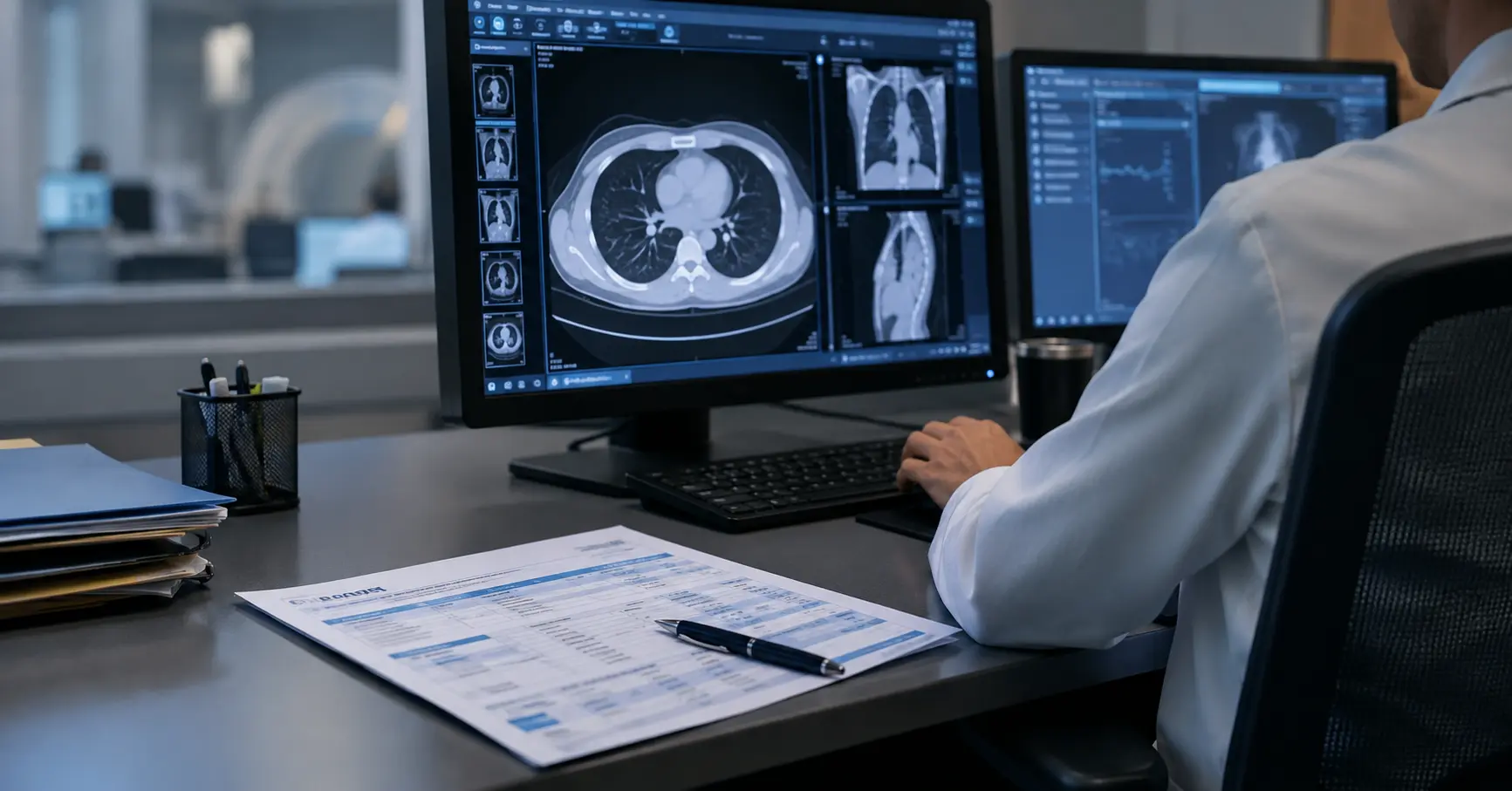
A radiologist is a physician who specializes in interpreting medical images, X-rays, CT scans, MRIs, ultrasounds, and nuclear medicine studies, to diagnose and, in some cases, treat disease. It's a specialty that sits in an unusual position within medicine: deeply clinical in its diagnostic reasoning, and simultaneously one of the more administratively complex specialties to bill correctly, given how radiology reimbursement splits between the technical work of producing an image and the professional work of interpreting it.
For radiology practices and imaging centers across Maryland, from hospital-based groups in Baltimore to independent imaging centers in Rockville or Frederick, that dual nature shapes daily operations as much as it shapes training. This guide walks through what radiologists actually do, how they train, where they practice, and the specific billing mechanics that make radiology revenue cycle management genuinely different from most other specialties.
What Does a Radiologist Do?
At the core, a radiologist interprets medical images and translates what they see into a diagnosis or a clinical recommendation. This involves reviewing the study itself, comparing it against prior imaging when available, and producing a written report that becomes part of the patient's medical record. Radiologists also serve as diagnostic decision support for referring physicians, often consulting directly with an ordering physician in Annapolis or Salisbury about which imaging study best fits a specific clinical question, or discussing an unexpected finding that changes a patient's care plan. Some radiologists, specifically interventional radiologists, also perform minimally invasive procedures guided by imaging, biopsies, catheter-based treatments, and vascular interventions, rather than working purely in an interpretive capacity.
Types of Radiology
Diagnostic radiology focuses on interpreting imaging studies to diagnose disease and injury, covering the majority of what most people associate with the specialty.
Interventional radiology uses imaging guidance to perform minimally invasive procedures, ranging from image-guided biopsies to vascular and oncologic interventions, blending diagnostic and procedural work.
Subspecialties within radiology allow for deeper focus on a specific body system or imaging modality, including neuroradiology, breast imaging, musculoskeletal radiology, pediatric radiology, nuclear radiology, and others, each typically requiring additional fellowship training beyond core residency.
Radiologist Training and Career Path
The training pathway is longer than many people expect. It begins with four years of medical school, followed by a required one-year preliminary or transitional internship year, typically in internal medicine, general surgery, pediatrics, or a transitional program, completed before diagnostic radiology residency itself even begins.
From there, physicians complete a four-year ACGME-accredited diagnostic radiology residency. According to the American Board of Radiology, residents become eligible to take the Qualifying, or Core, Exam after 36 months of residency training, with the Certifying Exam following approximately 15 months after residency completion. Many radiologists then pursue an additional one-year fellowship in a specific subspecialty, neuroradiology, breast imaging, musculoskeletal imaging, and others, to develop focused expertise before entering practice. Interventional radiology has its own dedicated integrated residency pathway for physicians planning to specialize in image-guided procedures from the start of training.
Board certification through the American Board of Radiology, maintained through ongoing continuing education requirements, is the standard credential radiology practices and hospital credentialing committees across Maryland expect before granting privileges.

Where Can Radiologists Practice?
- Hospitals, providing imaging interpretation across inpatient, emergency, and outpatient hospital-based services.
- Independent radiology groups, contracting with hospitals and imaging centers while remaining a separate business entity.
- Outpatient imaging centers, common across suburban Maryland communities like Columbia, Bel Air, and Gaithersburg, offering diagnostic imaging outside a hospital setting.
- Academic settings, combining clinical interpretation with teaching and research.
- Teleradiology, interpreting studies remotely, often across multiple facilities or even multiple states.
- Private practice, whether solo or group-based, serving a specific regional patient base directly.

Starting or Joining a Radiology Practice
Radiologists considering practice options face a similar decision to physicians in other specialties: employment, group practice, or independent practice, each with different tradeoffs around autonomy, income structure, and administrative responsibility. Employment through a hospital system offers predictable structure with limited business responsibility. Group practice, common among radiology groups contracting across multiple Maryland facilities, offers shared infrastructure and negotiating leverage. Independent practice offers full control paired with full responsibility for staffing, imaging technology investment, and practice infrastructure.
Technology considerations weigh more heavily in radiology than in many specialties, given the capital investment involved in imaging equipment and the picture archiving and communication systems, or PACS, that store and transmit studies. A radiology group in Towson or Hagerstown weighing independent practice needs to factor equipment costs directly into its business plan in a way most non-radiology specialties don't.
Radiology Credentialing and Payer Enrollment
Radiology credentialing follows the same core framework as other specialties, an accurate NPI and taxonomy code designation, a current CAQH profile, Medicare enrollment through PECOS, state Medicaid enrollment, and individual commercial payer applications, but radiology adds a layer of complexity around group versus individual enrollment. A radiologist joining a group that bills globally for hospital-based imaging needs enrollment correctly reflecting that group relationship, while a radiologist billing independently for the professional component of services needs their own enrollment accurately reflecting that distinct billing arrangement.
Enrollment delays affect radiology billing in a specific, direct way: since much of radiology billing depends on the professional component being correctly attributed to the interpreting physician, an enrollment gap can stall an entire category of claims, not just claims tied to a single new patient relationship. New internal medicine and radiology practices alike can work with Edge RCM to manage payer credentialing and enrollment requirements, helping ensure provider information is accurate and enrollment is active before billing begins.
Common Radiology Billing and Reimbursement Challenges
Radiology billing carries specific complexity that sets it apart from most other specialties.
The professional and technical component split
Most imaging services split into a technical component, covering equipment, supplies, staff, and facility costs, and a professional component, covering the radiologist's interpretation and report. According to Noridian, a Medicare Administrative Contractor, Medicare pays for the technical component under the Medicare Physician Fee Schedule specifically for beneficiaries who are not hospital patients and who receive services in a physician's office, freestanding imaging center, or similar non-hospital setting. Modifier 26 identifies the professional component alone, modifier TC identifies the technical component alone, and no modifier indicates a global claim where the same entity owns the equipment and performs the interpretation.
A critical structural rule directly from Noridian's own guidance: radiologists providing services to Medicare patients in a hospital or facility setting cannot claim the technical component of a procedure, since the facility itself bills for that portion. Getting this distinction wrong, billing globally for a study interpreted at a facility the radiology group doesn't own, is a well-documented source of duplicate billing denials and potential recoupment risk.

Other recurring challenges
- Coding errors, particularly selecting the wrong modifier for the specific billing arrangement involved.
- Eligibility issues, since imaging is often scheduled separately from the ordering visit, creating a gap where coverage can change between order and study.
- Prior authorization, especially for advanced imaging like MRI and CT, which many payers subject to stricter authorization requirements than routine X-rays.
- Documentation, since the interpretation report itself needs to clearly support medical necessity for the specific study performed.
- Claim submission and payment delays, compounded when technical and professional components are billed by different entities that need to coordinate accurately.
Radiology Claim Denials
Several denial patterns show up consistently in radiology billing.
- Eligibility-related denials, when coverage active at the time of the ordering visit has changed by the time the imaging study is actually performed.
- Authorization problems, particularly for advanced imaging requiring prior approval that wasn't obtained or doesn't match the study actually performed.
- Medical necessity denials, when the interpretation report or ordering documentation doesn't clearly connect the clinical indication to the specific study billed.
- Coding and modifier errors, especially incorrect use of modifier 26, TC, or global billing given the specific ownership and employment arrangement involved.
- Provider enrollment mismatches, when the interpreting radiologist's enrollment doesn't correctly reflect their group affiliation or practice location.

Identifying recurring denial patterns requires tracking denials by specific reason and by billing arrangement, since a pattern concentrated around modifier errors points to a different fix than one concentrated around authorization gaps.
Building an Efficient Radiology Revenue Cycle
A well-functioning radiology revenue cycle depends on eligibility verification happening before the imaging study, not just before the ordering visit, accurate charge capture reflecting the correct component split, careful claim review before submission specifically checking modifier accuracy, clean claim submission, disciplined payment posting, active accounts receivable monitoring, and structured denial management that traces denials back to root cause rather than correcting each one in isolation.
How Radiology Practices Can Reduce Administrative Burden
Some administrative functions make sense to keep in-house, particularly day-to-day scheduling and direct referring physician relationships that benefit from local familiarity. Other functions, especially the specialized coding knowledge required for accurate PC/TC billing, credentialing across multiple facilities and payers, and ongoing denial management, are often more efficiently handled by a partner with specific radiology billing expertise. Edge RCM can support radiology practices across Maryland with credentialing, medical billing, claims management, and revenue cycle workflows, helping practices in Baltimore, Rockville, and communities throughout the state manage the administrative complexity that comes with radiology's professional and technical component billing structure, so radiologists can focus on interpretation and patient care rather than claim-level troubleshooting.
Frequently Asked Questions
What does a radiologist do?
A radiologist interprets medical imaging studies, X-rays, CT scans, MRIs, ultrasounds, and nuclear medicine studies, to diagnose disease and injury, and communicates findings to referring physicians. Interventional radiologists additionally perform minimally invasive, image-guided procedures.
How long does it take to become a radiologist?
The pathway includes four years of medical school, a required one-year preliminary internship, a four-year ACGME-accredited diagnostic radiology residency, and often an additional one-year fellowship for subspecialty training, totaling roughly nine to ten years of training after starting medical school.
What is the difference between diagnostic and interventional radiology?
Diagnostic radiology focuses on interpreting imaging studies to diagnose conditions, while interventional radiology uses imaging guidance to perform minimally invasive procedures, such as biopsies and catheter-based treatments.
Do radiologists need credentialing?
Yes. Radiologists need accurate NPI and taxonomy designation, a current CAQH profile, Medicare and Medicaid enrollment, and commercial payer credentialing, with particular attention to whether enrollment reflects individual or group billing arrangements.
Why are radiology claims denied?
Common causes include eligibility changes between the ordering visit and the imaging study, missing or mismatched prior authorization, medical necessity documentation gaps, incorrect use of professional and technical component modifiers, and provider enrollment mismatches.
What is professional versus technical component billing?
The technical component covers the equipment, supplies, and facility costs of performing an imaging study, billed with modifier TC. The professional component covers the radiologist's interpretation and report, billed with modifier 26. When the same entity owns the equipment and performs the interpretation, the service is billed globally without either modifier.
Conclusion
Radiology sits at an unusual intersection of highly specialized clinical training and genuinely distinct billing complexity. Understanding how professional and technical components split, how enrollment needs to reflect individual versus group billing arrangements, and where denial patterns tend to concentrate gives radiology practices across Maryland, from hospital-based groups in Baltimore to independent imaging centers in Frederick and Salisbury, a real foundation for protecting the revenue behind the clinical work already being done well.
Edge RCM CTA
Radiology billing's professional and technical component structure creates administrative complexity most other specialties don't face, and getting it wrong shows up quickly as denials or delayed reimbursement. Edge RCM, based in Reisterstown, supports radiology practices and imaging centers across Maryland with credentialing, payer enrollment, medical billing, and denial management built around radiology's specific billing structure.
Important Links
What Healthcare Providers Say About Edge RCM
Owner · Hospice and Palliative Board Review · Clarksville, MD
Owner · Baycove Home Care LLC · Houston, TX