NPI vs. Taxonomy vs. PTAN: Key Differences Every Medical Practice Should Know
NPI, taxonomy code, and PTAN all show up on the same enrollment and credentialing forms, which is exactly why practices confuse them. This guide breaks down what each identifier actually does, how Type 1 and Type 2 NPIs differ, why the correct taxonomy code matters for enrollment and payment, how PTAN fits into Medicare specifically, and where mismatches between these identifiers commonly cause denials and credentialing delays.
NPI vs. Taxonomy vs. PTAN: Key Differences Every Medical Practice Should Know
Why Providers Confuse NPI, Taxonomy, and PTAN
Ask a credentialing coordinator to explain the difference between an NPI, a taxonomy code, and a PTAN, and you'll usually get a pause before the answer. That hesitation makes sense. All three show up on the same enrollment applications, often requested in the same breath, and all three feel like variations on the same idea: a number that identifies a provider to a payer.
They're not interchangeable, though, and treating them that way is exactly what causes credentialing delays and avoidable claim denials. This guide breaks down what NPI, taxonomy, and PTAN each actually do, how they relate to one another, and where practices most often get them tangled.
NPI vs. Taxonomy vs. PTAN: The Quick Comparison
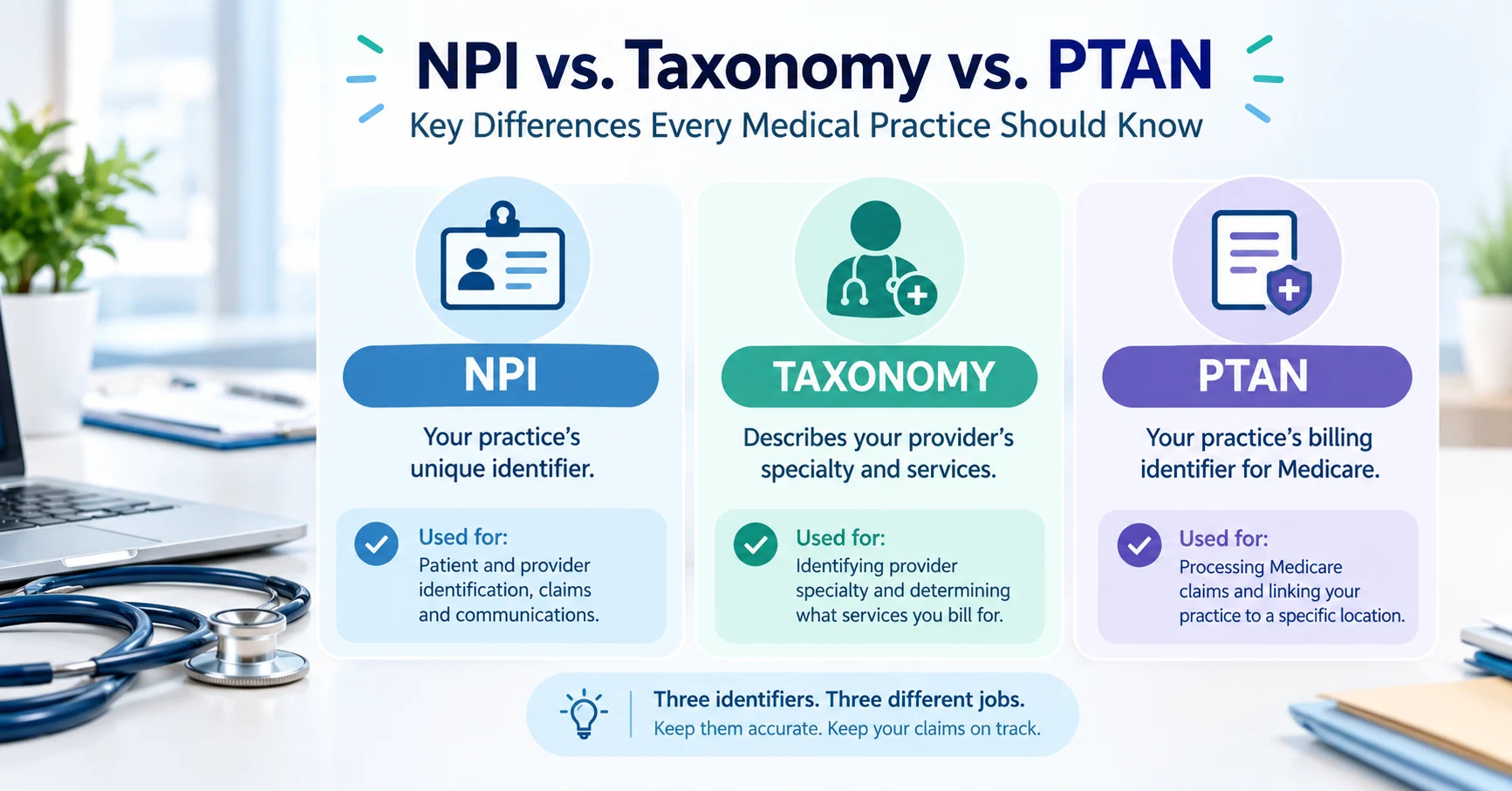
In short: the NPI identifies who the provider is, the taxonomy code identifies what kind of provider they are, and the PTAN identifies that provider's specific relationship with Medicare. The NPI is universal across every HIPAA-covered payer. The taxonomy code rides alongside the NPI to describe specialty and classification. The PTAN exists only within Medicare and never appears on a claim.
What Is an NPI Number?
A National Provider Identifier is a 10-digit standard identifier required under HIPAA for all electronic healthcare transactions. It's issued through the National Plan and Provider Enumeration System, commonly called NPPES, and it's free, with no renewal requirement.
Type 1 NPI vs. Type 2 NPI
A Type 1 NPI identifies an individual provider, a physician, nurse practitioner, or other licensed clinician. An individual holds exactly one Type 1 NPI for life, regardless of how many specialties, states, or practice locations accumulate over a career, and regardless of who employs them. The NPI belongs to the individual, not the employer, and it travels with them when they change jobs.
A Type 2 NPI identifies an organization, a group practice, hospital, or other incorporated healthcare business. Unlike Type 1, an organization can hold multiple Type 2 NPIs, commonly used to represent separate locations or subparts of the same organization. A Type 2 NPI doesn't expire, but the record needs to be updated within 30 days of a change to the business name or address.
When providers and organizations need an NPI
A sole proprietor generally only needs a Type 1 NPI. A provider who has incorporated, as an LLC or professional corporation for example, typically needs both: a Type 1 for themselves as an individual and a Type 2 for the business entity itself.
What Is a Provider Taxonomy Code?
A taxonomy code is a 10-character code from the National Uniform Claim Committee code set that designates a provider's classification and specialization. According to CMS, this code is required as part of the NPI application itself, since NPPES needs to know what type of provider is being enumerated.
How taxonomy codes identify provider specialty and classification
A provider can select more than one taxonomy code if they practice across multiple specialties or classifications, but one must be designated as the primary code. This primary designation matters, since it's what payers and enrollment systems typically default to when processing claims and credentialing decisions.
Why the correct taxonomy code matters for enrollment and claims
Getting the taxonomy code wrong isn't a cosmetic error. CMS has required pharmacies to deny prescriptions when the prescribing provider's correct taxonomy code isn't on file. Medicaid, HARP, and Child Health Plus programs mandate that health plans submit both NPI and taxonomy code as a condition of payment. An incorrect or missing taxonomy code can delay credentialing and, in some cases, block payment entirely, not just slow it down.
What Is a PTAN Number?
A Provider Transaction Access Number is a Medicare-specific identifier, sometimes referred to as a Medicare Provider Number, Medicare Billing Number, or CMS Certification Number, assigned by a Medicare Administrative Contractor once a provider's Medicare enrollment is approved through PECOS, the Provider Enrollment, Chain, and Ownership System.
How PTAN differs from an NPI
The most important distinction is this: the PTAN is not submitted on claims. Where the NPI is public and universal across every payer, the PTAN is private and used exclusively to authenticate a provider's identity when communicating directly with their MAC, for example when calling about a claims issue or enrollment question. A PTAN cannot exist without a prior, valid NPI, since Medicare enrollment itself requires an NPI as a prerequisite.
Why Medicare assigns PTANs
The PTAN allows Medicare to track enrollment status, manage billing privileges, apply geographic jurisdiction rules, and associate a specific provider with the correct regional MAC responsible for processing their claims. It's issued automatically as part of enrollment approval, at no cost to the provider.
NPI vs. Taxonomy vs. PTAN: Key Differences at a Glance
- Issuing authority: NPI comes from CMS through NPPES. Taxonomy codes come from the National Uniform Claim Committee code set. PTAN comes from a specific Medicare Administrative Contractor.
- Scope: NPI is universal across all HIPAA-covered payers. Taxonomy travels with the NPI application and claims. PTAN is Medicare-only.
- Appears on claims: NPI, yes. Taxonomy code, yes, as supporting classification data. PTAN, no.
- Cost and renewal: All three are issued at no cost. NPI and PTAN don't expire but require updates when underlying information changes.
- Who it identifies: NPI identifies the specific provider or organization. Taxonomy identifies the type of provider. PTAN identifies the provider's Medicare enrollment relationship specifically.
How NPI, Taxonomy, and PTAN Work Together
These three identifiers function as layers, not substitutes for one another. A provider first obtains an NPI, selecting the taxonomy code that reflects their classification as part of that NPPES application. Once the NPI exists, the provider can enroll in Medicare through PECOS, and upon approval, Medicare's system assigns a PTAN tied to that NPI and the specific MAC jurisdiction. Miss a step, or let one piece drift out of sync with the others, and the whole chain can break down at the point a claim actually gets submitted.
When Each Identifier Is Used in Medical Billing and Credentialing
The NPI appears on essentially every claim submitted to any payer, Medicare, Medicaid, or commercial. The taxonomy code typically accompanies the NPI on claims and enrollment applications to specify exactly what kind of provider rendered the service. The PTAN comes into play specifically during Medicare enrollment, revalidation, and any direct communication with a MAC, but it never appears on the claim form itself.
Common NPI, Taxonomy, and PTAN Mistakes Medical Practices Make
- Using an individual Type 1 NPI where a facility or organizational enrollment application requires a Type 2 NPI, which results in the application being returned for correction.
- Selecting an outdated or overly general taxonomy code instead of the one that accurately reflects the provider's actual specialty and classification.
- Assuming the PTAN needs to be included on claims, when it's actually used only for direct MAC communication and authentication.
- Letting a provider's NPI record fall out of sync with their Tax Identification Number in a specific payer's system, a mismatch that remains one of the most common causes of denials tied to provider identifiers.
- Failing to update a Type 2 NPI record within the required window after a business name or address change.
- Not designating a clear primary taxonomy code when a provider holds more than one, leaving payer systems to default inconsistently.
How Incorrect Provider Information Can Affect Claims and Enrollment
An NPI and taxonomy mismatch, or an NPI that isn't properly linked to the correct TIN in a payer's database, is a well-documented, recurring cause of claim denials that have nothing to do with the clinical service itself. On the enrollment side, an incorrect entity type or taxonomy selection routinely sends applications back for correction, adding weeks to a process that should have gone through cleanly the first time. These aren't rare edge cases. They're some of the most common, most preventable administrative denials practices deal with.
How to Verify and Keep Provider Information Up to Date
- Confirm each provider's NPPES record reflects their current, correct primary taxonomy code, not one carried over from an earlier point in their career.
- Verify that Type 1 and Type 2 NPIs are both current and properly linked where a provider operates through an incorporated practice.
- Cross-check that the NPI on file with each payer matches the TIN associated with that specific billing arrangement.
- Confirm PTAN status directly with the relevant MAC during Medicare revalidation cycles, rather than assuming it's still accurate.
- Update NPPES records within the required window whenever a practice changes its business name, address, or organizational structure.
What Practices Should Review When Adding a New Provider
Confirm whether the new provider needs a Type 1 NPI only, or both a Type 1 and Type 2 if they're joining as an incorporated entity. Select the taxonomy code that accurately reflects their actual specialty, not the closest available option. Begin Medicare enrollment through PECOS promptly if the provider will bill Medicare, since PTAN assignment depends on that enrollment being approved first. Confirm the new provider's NPI is correctly linked to the practice's TIN across every payer the practice bills, not just the primary ones.
Frequently Asked Questions
What is the difference between an NPI and a taxonomy code?
An NPI is a unique identifier for a specific provider or organization. A taxonomy code identifies that provider's classification and specialty, and it's submitted as part of the NPI application and often alongside claims to describe what type of provider rendered the service.
What is the difference between an NPI and a PTAN?
An NPI is a universal identifier used across all HIPAA-covered payers and appears on claims. A PTAN is a Medicare-specific identifier used only to authenticate a provider's identity when communicating with their Medicare Administrative Contractor, and it does not appear on claims.
Does every provider need both a Type 1 and Type 2 NPI?
No. A sole proprietor generally only needs a Type 1 NPI. A provider operating through an incorporated business, such as an LLC or professional corporation, typically needs both a Type 1 for themselves and a Type 2 for the organization.
Can an individual have more than one Type 1 NPI?
No. An individual holds exactly one Type 1 NPI for life, regardless of how many specialties, locations, or employers they have over their career.
Why does the correct taxonomy code matter for claims and enrollment?
An incorrect or missing taxonomy code can delay credentialing and, in some cases, block payment entirely. CMS has required pharmacies to deny prescriptions when a prescribing provider's correct taxonomy code isn't on file, and several government programs mandate accurate taxonomy submission as a condition of payment.
How is a PTAN assigned?
A PTAN is assigned automatically by a Medicare Administrative Contractor once a provider's Medicare enrollment application, submitted through PECOS, is approved. A valid NPI must already exist before a PTAN can be issued.
Does the PTAN need to be included on Medicare claims?
No. The PTAN is used only for direct authentication when a provider or their billing staff communicates with their MAC. It is not submitted on claims, which use the NPI instead.
What happens if a provider's NPI and taxonomy code don't match their actual specialty?
This can result in claim denials, credentialing delays, or applications being returned for correction, since payers and enrollment systems rely on the taxonomy code to confirm the provider is appropriately classified for the service being billed.
What other provider identifiers might a practice need to track?
Beyond NPI, taxonomy, and PTAN, practices often manage a Tax Identification Number or EIN, a DEA number for controlled substance prescribing, a state license number, and a CLIA number for laboratory certification, each serving a distinct administrative purpose.
How often should a practice verify its providers' NPI and taxonomy information?
Reviewing this information during onboarding, whenever a provider's specialty or practice structure changes, and during Medicare revalidation cycles helps catch mismatches before they turn into denials or enrollment delays.
Conclusion
Keeping Provider Identifiers Aligned Across Enrollment and Billing
NPI, taxonomy code, and PTAN each serve a distinct, necessary function, and the confusion between them isn't really about the concepts being complicated. It's about how often they show up together on the same forms, doing different jobs that look similar at a glance. A practice that keeps these three identifiers accurate, current, and properly linked across every payer relationship avoids a category of denials and credentialing delays that have nothing to do with clinical care and everything to do with administrative precision.
Edge RCM CTA
Mismatched provider identifiers are a quiet but persistent source of denials and credentialing delays, and they're also some of the most preventable once a practice has a reliable process for catching them. Edge RCM works with practices on provider enrollment accuracy, NPI and taxonomy verification, and denial management tied to identifier mismatches, helping make sure the administrative foundation behind every claim is solid before the claim ever goes out. If your practice is onboarding a new provider or reviewing an existing enrollment, Edge RCM can help you confirm everything lines up.