How Credentialing Automation Eliminates Manual Provider Work
Manual credentialing still runs on spreadsheets, phone calls, and repeated data entry across a dozen different verification sources, and every day it drags on is a day of lost billable revenue. This article breaks down exactly which manual tasks credentialing automation actually eliminates, what changed with 2026 monitoring requirements, and how practices should evaluate whether automation or outsourced support makes more sense for their size and volume
Introduction
Ask any credentialing coordinator what their week actually looks like, and you'll hear some version of the same story. Calling state licensing boards to confirm a license is active. Logging into CAQH to check whether a provider's attestation is current. Re-typing the same demographic and education information into a payer's portal that already exists somewhere else in the system. Chasing a physician for a malpractice insurance certificate that expired three weeks ago and nobody caught.
None of that work is clinical. None of it requires a medical degree. And all of it stands directly between a fully qualified provider and their first billable patient visit. That gap is exactly what credentialing automation is built to close, not by removing judgment from the process, but by removing the repetitive, error-prone manual work that judgment doesn't actually require.
This article breaks down what credentialing automation actually eliminates, task by task, what's changed recently that makes this more urgent, and how practices should think about implementing it well.
Why Manual Credentialing Still Costs Practices So Much
The numbers on manual credentialing delays are consistent enough across the industry to be worth taking seriously. According to MGMA, the credentialing process still takes anywhere from 90 to 180 days on average. A 2024 AAPPR poll of 167 healthcare recruitment professionals found that 70 percent of organizations report the process takes three to four months, and nearly a quarter said it stretches to six.
Every one of those days carries a real cost. Research cited by Neolytix found that more than 40 percent of healthcare organizations lose up to $50,000 monthly in billable revenue due to credentialing delays, with one in four losing more than $100,000 a month. Separate analysis has estimated that a single physician can lose more than $122,000 in income during a 120-day credentialing delay. These aren't abstract industry benchmarks. They're the direct, calculable cost of a provider who is fully qualified, fully hired, and still not allowed to bill for the work they're ready to do.
Where the time actually goes
- Manually verifying a medical license against a state board typically takes three to five days per provider when done by phone or by checking a board's website individually.
- DEA registration verification runs a similar two to three days when handled manually.
- Re-entering the same provider data across multiple payer portals, CAQH, and internal systems introduces both delay and a real risk of transcription error.
- Tracking expiring licenses, certifications, and insurance policies across a growing provider roster becomes harder to manage reliably as a practice or health system scales, particularly when that tracking still lives in a spreadsheet.
None of this is a reflection of credentialing staff working slowly. It's a reflection of a process built around manual, one-at-a-time verification against sources that were never designed to be checked efficiently at scale.
What Credentialing Automation Actually Does
It's worth being precise about what automation changes here, because the goal isn't to remove people from credentialing. It's to remove the repetitive parts of the job that don't actually require a trained specialist's judgment, so that judgment gets applied where it matters, resolving a flagged discrepancy, following up with a slow-moving payer, making a final credentialing decision.
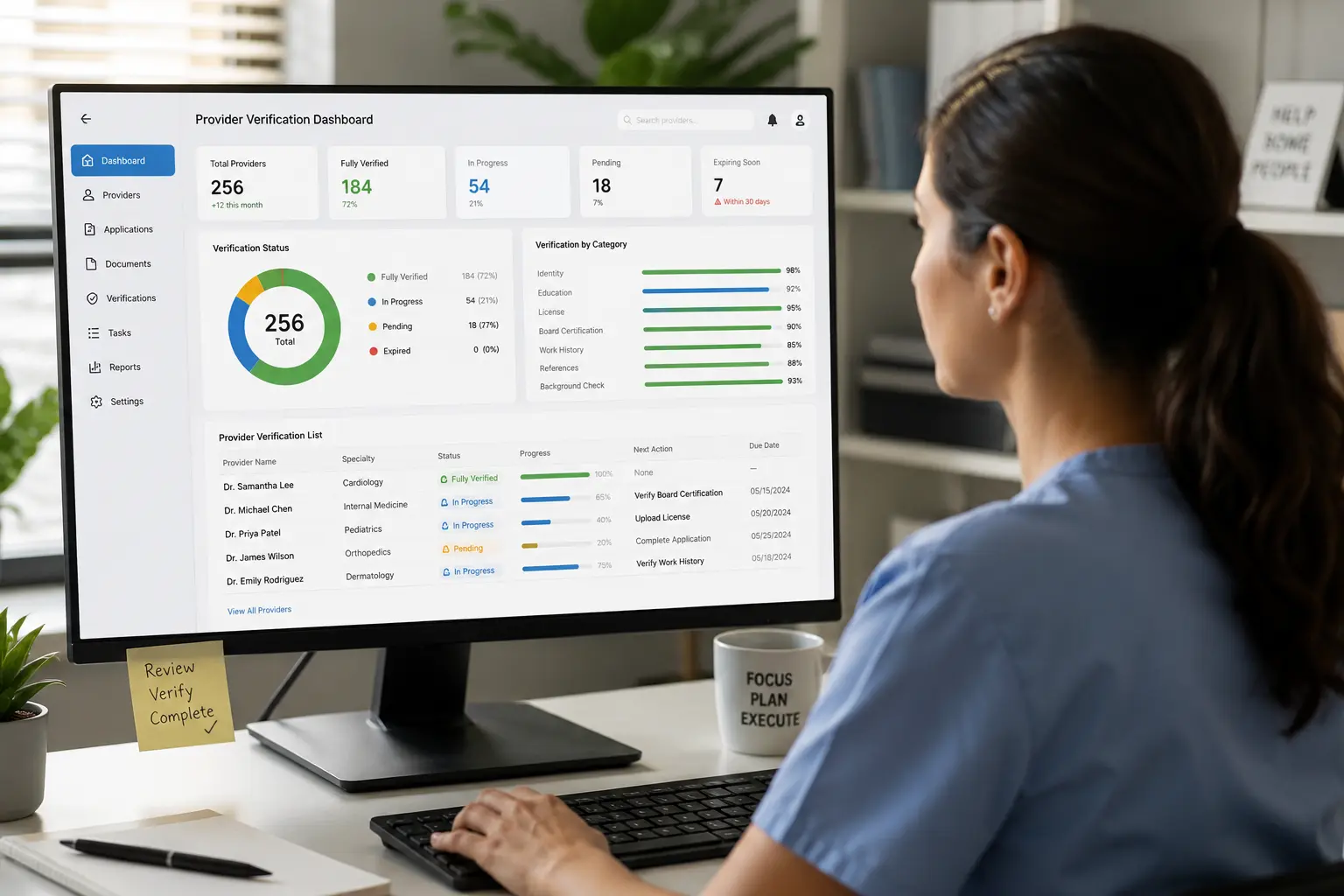
Automated credentialing platforms typically combine a few core technologies. Robotic process automation handles repetitive, rule-based tasks like form completion and routine primary source queries. Artificial intelligence and optical character recognition extract data directly from uploaded documents instead of requiring manual entry. Machine learning flags inconsistencies and prioritizes files that actually need human review. Direct integrations with primary sources, including state licensing boards, the National Practitioner Data Bank, CAQH, NPPES, OIG, and SAM.gov, let the system query these sources directly rather than requiring a coordinator to check each one individually.
Instead of a coordinator manually confirming a license is active, the system queries the state board directly and returns a verified result in a fraction of the time. Instead of retyping provider information into five different portals, the data gets entered once and synced everywhere it's needed.
Where Automation Eliminates the Most Manual Work
Breaking this down by task makes the actual impact clearer than a general description of "automation" ever does.
Primary source verification
This is the single biggest time sink in manual credentialing, and it's where automation makes the most dramatic difference. Automated verification can confirm a medical license in about a minute, compared to three to five days manually. DEA registration verification runs a similar pattern, roughly a minute automated versus two to three days by hand. Multiplied across a full provider roster, that difference alone accounts for a meaningful share of the 90-to-180-day average timeline shrinking down considerably.
Document collection and data entry
Rather than a provider emailing documents that a coordinator then has to open, read, and manually enter into the credentialing system, AI-powered document classification and data extraction can pull the relevant information directly from uploaded files. Some platforms report this eliminates up to 70 percent of manual data entry, which also meaningfully reduces the transcription errors that come from repetitive manual entry.
Ongoing monitoring and exclusion screening
Confirming a provider hasn't been excluded from federal healthcare programs isn't a one-time task. It has to be checked on an ongoing basis against sources like the OIG exclusion list and SAM.gov. Automated systems run this monitoring continuously in the background rather than relying on a coordinator remembering to run a manual check on some periodic schedule.
Re-credentialing and expirables tracking
Licenses, board certifications, and malpractice coverage all expire, and manually tracking renewal dates across a growing roster is exactly the kind of task that quietly fails at scale. Automated expirables monitoring with real-time alerts has been shown to reduce missed renewals by up to 80 percent in organizations that adopt it, turning a task that used to depend on someone remembering into a system that flags it automatically.
CAQH synchronization and payer enrollment coordination
CAQH profile drift, meaning small inconsistencies or lapsed attestations that accumulate over time, is a common, quiet cause of enrollment delays. Automated daily synchronization with CAQH catches these issues before they turn into a revalidation failure or a rejected payer application, rather than surfacing the problem only when an enrollment gets stuck.
What Changed in 2026 That Makes This More Urgent
Credentialing automation has been a growing trend for a few years now, but a specific regulatory change in 2026 raises the stakes for organizations still relying on manual processes.
NCQA's 2025 credentialing standards, effective July 1, mandate monthly OIG and SAM.gov exclusion screening across all active providers, not just at initial credentialing or on an annual cycle. For an organization with any meaningful provider roster, running that screening manually every single month, for every active provider, against multiple databases, is a workload that scales poorly and is genuinely difficult to sustain reliably without some form of automated monitoring. This is exactly the kind of requirement that makes manual compliance tracking structurally insufficient rather than just inconvenient.
Beyond this specific mandate, payer requirements and state rules continue to shift, and organizations still depending on spreadsheets and manual checklists are finding the margin for delay and error shrinking at the same time regulatory scrutiny is increasing.
Common Mistakes Practices Make When Automating Credentialing
- Assuming automation software alone solves the problem without dedicating staff time to actually reviewing flagged discrepancies and exceptions the system surfaces.
- Choosing a platform based on interface and pricing alone without confirming it integrates directly with the primary sources that matter most for the organization's specialty mix and state footprint.
- Migrating to automated tracking without cleaning up existing provider data first, which just moves inaccurate or outdated information into the new system faster.
- Underestimating onboarding and training time, since even a well-designed platform requires staff to learn new workflows before the efficiency gains show up.
- Treating re-credentialing and ongoing monitoring as separate from initial credentialing automation, when the recurring compliance burden, especially under the new monthly exclusion screening requirement, is often where automation delivers the most sustained value.
- Not tracking first-pass approval rates and cycle time before and after implementation, which makes it hard to actually measure whether the automation investment is working as intended.
Actionable Tips for Choosing and Implementing Credentialing Automation
- Confirm direct integration with the specific primary sources your provider mix actually requires, state licensing boards, NPDB, CAQH, NPPES, OIG, SAM.gov, and DEA, rather than assuming broad compatibility.
- Clean and standardize existing provider data before migrating to a new system, so automation isn't just accelerating the spread of outdated information.
- Prioritize platforms with strong exclusion monitoring and expirables tracking specifically, given the 2026 monthly screening requirement and the outsized cost of missed renewals.
- Set a baseline for your current credentialing cycle time and first-pass approval rate before implementation, so you can actually measure the impact afterward.
- Keep experienced credentialing staff involved in reviewing flagged exceptions rather than assuming automation removes the need for human judgment entirely.
- Ask vendors directly about parallel processing capability, since the ability to run multiple credentialing files simultaneously, rather than sequentially, is often what separates a meaningful cycle time reduction from a marginal one.
Expert Recommendations
Organizations that get real value out of credentialing automation tend to approach it as a workflow redesign, not just a software purchase. The technology removes the repetitive verification and data entry work, but someone still needs to own the process, review what the system flags, and maintain the relationships with payers and credentialing committees that automation can't replace on its own.
It's also worth resisting the instinct to automate everything at once. Practices that start with the highest-volume, most time-consuming manual tasks, typically primary source verification and expirables tracking, tend to see faster, more measurable returns than those trying to overhaul the entire credentialing function simultaneously. Once that core automation is working reliably, expanding into more specialized tracking, like CAQH synchronization or payer-specific enrollment workflows, becomes a much smaller lift.
Given how directly credentialing delays translate into lost billable revenue, it's also worth connecting credentialing timelines to your practice's broader revenue cycle reporting, rather than treating credentialing as a purely administrative function tracked separately from the financial impact it actually has.
Frequently Asked Questions
What is credentialing automation?
Credentialing automation is the use of technology, including robotic process automation, artificial intelligence, and direct integrations with primary sources like state licensing boards and CAQH, to handle provider verification, tracking, and monitoring tasks without requiring manual effort at every step.
How long does manual provider credentialing typically take?
According to MGMA, the credentialing process typically takes 90 to 180 days when handled manually, though this varies by payer type, state, and provider specialty.
How much does a credentialing delay actually cost a practice?
Research cited by Neolytix found that more than 40 percent of healthcare organizations lose up to $50,000 monthly in billable revenue due to credentialing delays, with one in four losing more than $100,000 a month. Separate analysis has estimated an individual physician can lose more than $122,000 in income during a 120-day delay.
Does credentialing automation eliminate the need for credentialing staff?
No. Automation removes repetitive, manual verification and data entry work, but trained staff are still needed to review flagged discrepancies, manage payer relationships, and make final credentialing decisions.
What primary sources does credentialing automation typically verify against?
Common sources include state medical and licensing boards, the National Practitioner Data Bank, CAQH, NPPES, the OIG exclusion list, SAM.gov, and DEA registration databases.
What changed with credentialing compliance requirements in 2026?
NCQA's 2025 standards, effective July 1, mandate monthly OIG and SAM.gov exclusion screening across all active providers, rather than a less frequent cycle, which makes manual compliance tracking significantly harder to sustain reliably.
How much faster is automated primary source verification compared to manual verification?
Automated verification can confirm a medical license in about a minute, compared to three to five days manually, and DEA registration in about a minute compared to two to three days manually.
Can credentialing automation reduce missed license or certification renewals?
Yes. Organizations using automated expirables monitoring with real-time alerts have reported missed renewals dropping by up to 80 percent compared to manual tracking.
Is credentialing automation only useful for large health systems?
No. While large systems see significant volume-based benefits, small and mid-sized practices facing the same 90-to-180-day manual timelines and the same 2026 monthly exclusion screening requirement can see meaningful benefits as well, particularly when combined with outsourced credentialing support for practices without dedicated in-house staff.
What should a practice do before implementing credentialing automation software?
Clean and standardize existing provider data, confirm the platform integrates directly with the specific primary sources relevant to the practice's specialty mix and states of operation, and establish a baseline credentialing cycle time to measure improvement against after implementation.
Conclusion
Manual credentialing was never really a clinical problem. It was always an administrative one, built on repetitive verification tasks, redundant data entry, and tracking systems that depend on someone remembering to check something before it lapses. That's precisely the kind of work automation is well suited to remove, not by taking judgment out of credentialing, but by clearing away everything that doesn't actually require it. With 2026's monthly exclusion screening requirement raising the compliance bar further, the case for automating at least the highest-volume manual tasks has gotten harder to ignore.
Edge RCM CTA
Credentialing delays translate directly into lost billable revenue, and manual verification, data entry, and expirables tracking are exactly the kind of work that shouldn't be standing between a qualified provider and their first patient visit. Edge RCM works with practices on credentialing and provider enrollment support, including primary source verification coordination, CAQH accuracy review, payer enrollment tracking, and ongoing compliance monitoring. If your practice is still managing credentialing manually and feeling the revenue impact of it, Edge RCM can help you build a faster, more reliable process.