AI vs. Human Medical Coders: Striking the Right Balance
A practical, provider-focused comparison of AI and human medical coders in 2026, covering what AI coding tools do well, where human judgment still wins, the accuracy and compliance risks of over-relying on automation, and how to build a hybrid workflow that protects both revenue and audit defense.
AI vs. Human Medical Coders: Striking the Right Balance
Ask ten coding managers what they think about AI coding tools and you will get ten different answers. Some are already running AI-assisted coding across most of their outpatient volume. Others tried a pilot, got burned by a compliance flag, and pulled back to fully manual review. Most practices sit somewhere in between, curious but cautious.
That caution is reasonable. Medical coding sits at the exact intersection of clinical documentation, payer policy, and reimbursement, which means a coding mistake does not just slow down a claim, it can trigger a denial, an audit, or a compliance finding. AI has genuinely changed what is possible in this space, but it has not changed the fact that someone accountable needs to stand behind every code that goes out the door. This guide walks through where AI earns its keep, where human coders still matter more than ever, and how to combine the two without gambling your revenue cycle on either one alone.
How AI Is Changing Medical Coding in 2026
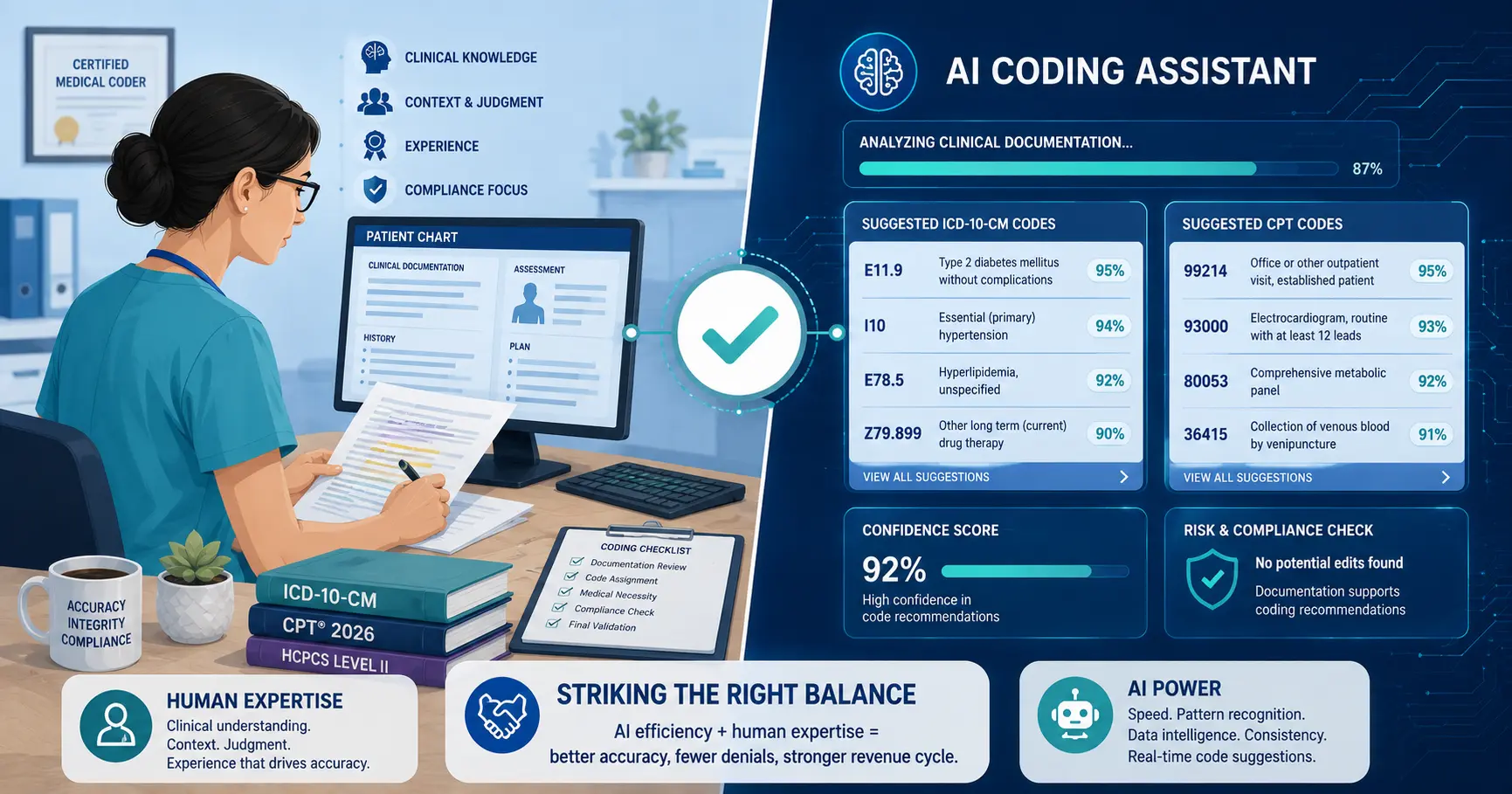
Medical coding used to mean a certified coder reading a chart line by line and manually selecting ICD-10-CM, CPT, and HCPCS codes. That model is still very much alive, but it is no longer the whole picture. Natural language processing and large language models can now read a clinical note, pull out the relevant diagnoses and procedures, and suggest a full code set in seconds rather than minutes.
Industry benchmark data published by AI coding vendors in 2025 and 2026 reports accuracy in the 92 to 97 percent range for high-volume, structured encounters like emergency department visits and outpatient radiology, dropping to roughly 82 to 90 percent for complex inpatient cases with multiple comorbidities. Those numbers vary by vendor and specialty, so treat any single figure as a starting point for due diligence, not a guarantee for your practice.
What has really shifted is adoption. Health system surveys cited by industry researchers in 2026 report that a large majority of health systems now plan to expand AI-driven automation in their revenue cycle this year, with autonomous or AI-assisted coding named as a top priority. The coding profession is not disappearing, but it is changing shape, moving from high-volume manual entry toward exception handling, audit defense, and quality oversight.
What AI Medical Coding Tools Can Do
AI coding tools are genuinely strong at a specific set of tasks. Understanding what those are helps you evaluate a platform honestly instead of buying into a vendor's full pitch.
- Reading structured, high-volume documentation quickly. Emergency department notes, radiology reports, and routine outpatient visits with consistent templates are where AI performs best.
- Applying payer-specific rules automatically. Leading platforms update code libraries and edit logic as ICD-10-CM and CPT changes roll out, including CMS's biannual guideline updates each April and October.
- Flagging low-confidence cases for human review. Good AI coding tools route ambiguous documentation to a human coder instead of forcing a code through.
- Reducing coding turnaround time. Several 2026 industry reports describe coding time reductions of around 40 percent for AI-assisted workflows.
- Providing an audit trail. Since every suggested code ties back to specific documentation, AI tools can make it easier to show why a code was selected during a payer audit.
None of this means the software understands medicine the way a trained coder does. It means the software is good at pattern matching across large volumes of relatively predictable documentation, things like routine office visits, emergency department encounters, and radiology or pathology reports with consistent structure.
Where Human Medical Coders Still Have the Advantage
The cases that trip up AI are usually the same cases that require years of coder training to handle well. This is where human judgment continues to outperform automated systems, and probably will for some time.
- Complex, multi-condition inpatient stays. When a patient has five or six interacting diagnoses across notes from different specialists, sequencing and code selection require clinical reasoning that goes beyond text matching.
- Ambiguous or contradictory documentation. A physician's note that says one thing and a nursing note that implies another needs a human to resolve, often through a compliant physician query.
- Cardiology and other high-specificity specialties. Distinguishing systolic versus diastolic heart failure, or sequencing an exacerbation against an underlying chronic condition, depends on clinical interpretation AI can miss without explicit documentation cues.
- New or unusual procedures. AI models are trained on historical data, so a newly introduced CPT code may not have enough examples for the model to code confidently.
- Payer-specific medical necessity judgment calls. Knowing which diagnosis code satisfies a specific commercial payer's local coverage policy is still often institutional knowledge held by experienced coders.
- Physician query and documentation improvement. Coders who understand clinical nuance and compliance rules can craft a compliant query that actually improves documentation rather than leading the physician toward a code.
AI Coding Accuracy: Errors, Documentation, and Compliance Risks
Every conversation about AI coding accuracy needs to include the honest downside, because the compliance risks are real and the consequences land on the practice, not the software vendor.
Where AI Coding Errors Tend to Show Up
- Overreliance on keyword matching, where a term mentioned in a lab result or imaging report gets coded even though it was never confirmed by the treating provider
- Missed context that changes a code entirely, such as a diagnosis documented as "history of" versus an active condition
- Upcoding risk when a model defaults to the more specific or higher-weighted code without sufficient documentation to support it
- Unbundling errors on complex procedure claims where the AI does not fully account for payer-specific bundling edits
- Outdated code assignment if a platform's code library lags behind a mid-year CPT or ICD-10-CM update
Why Documentation Quality Still Drives Everything
AI coding is only as good as the documentation it reads. If a physician's note is vague, templated, or missing key clinical detail, the AI tool will either guess, which creates compliance risk, or flag the case for human review, which is the safer outcome but slows things down. Practices that invest in clinician documentation training alongside AI adoption tend to see better results than practices that treat AI as a fix for weak documentation.
The Compliance Reality
Federal fraud and abuse enforcement does not distinguish between a human coding error and an AI coding error. If a claim goes out with an unsupported code, the practice is accountable regardless of who or what selected it. That is why professional coding organizations continue to require documented human oversight of AI-suggested codes rather than fully autonomous submission in most clinical settings.
AI vs. Human Coders: Comparing Speed, Accuracy, and Judgment
Rather than framing this as a competition, it helps to look at the two side by side across the dimensions that actually matter to a practice.
- Speed: AI wins decisively on high-volume, structured encounters, often coding in seconds what would take a human coder several minutes.
- Accuracy on straightforward cases: AI performs comparably to experienced coders, sometimes catching codes a rushed human coder might miss during a high-volume shift.
- Accuracy on complex cases: Human coders generally outperform AI once documentation becomes ambiguous, contradictory, or clinically nuanced.
- Judgment and context: Humans understand intent, clinical narrative, and payer relationships in a way current AI models cannot fully replicate.
- Consistency: AI applies the same logic every time, which reduces variability between coders but also means a flawed rule gets applied consistently across every claim until someone catches it.
- Accountability: Only a credentialed human coder can sign off on a code with professional and legal accountability attached.
The honest takeaway is that AI and human coders are not really competing for the same job anymore. AI increasingly handles first-pass coding at scale, while human coders shift toward review, exception handling, and audit defense, the tasks that require actual clinical and regulatory judgment.
The Role of Human Review in AI Assisted Medical Coding
Human review is not a formality bolted onto AI coding to satisfy compliance, it is the mechanism that makes AI coding safe to use in the first place. A well-designed review process typically includes a few core elements.
- A confidence threshold that automatically routes low-confidence AI suggestions to a human coder rather than letting them pass through
- Random sampling of high-confidence AI-coded claims for periodic quality audits, since even high-confidence codes can be systematically wrong in ways that only a broader audit catches
- A clear escalation path for coders to flag documentation gaps back to clinicians
- Ongoing tracking of AI accuracy by encounter type, so the practice knows where the tool is strong and where it consistently needs more oversight
The American Health Information Management Association has been vocal about this shift, describing the emerging role for experienced coders as one of validation and oversight rather than pure production coding. That framing is useful for practices thinking through staffing: the coders you keep on staff after adopting AI are not doing less skilled work, they are doing more concentrated, higher-stakes work.
How AI Can Affect Claim Denials and Revenue Cycle Performance
Coding accuracy and claim denials are directly connected, which is exactly why this topic matters so much to a practice's bottom line. Industry estimates suggest that a substantial share of claim denials, often cited around 40 percent or more, trace back to coding-related issues rather than eligibility or authorization problems.
Used well, AI coding tools can reduce denial rates by catching missing specificity, applying current payer edits automatically, and flagging incomplete documentation before a claim ever goes out. Used poorly, meaning deployed without adequate human review, AI can actually increase denials by confidently submitting codes that do not hold up to payer scrutiny, which then creates rework, appeals, and delayed reimbursement that can outweigh the speed gains.
Actionable Tips to Protect Revenue Cycle Performance
- Track denial rates by encounter type before and after AI adoption, not just overall denial volume, to spot problem areas quickly
- Require human sign-off on any AI-suggested code above a defined dollar threshold or complexity level
- Build a feedback loop so denial reasons flow back to both the coding team and the AI vendor for model tuning
- Review AI vendor contracts for clarity on who is accountable for an incorrect code that leads to a denial or audit finding
AI and Human Coders: Building an Effective Hybrid Workflow
The practices getting the best results in 2026 are not choosing AI or human coders, they are designing a workflow where each does what it does best.
A Five-Step Hybrid Model
- Step one, AI first-pass coding. The AI tool reads the documentation and generates a suggested code set with a confidence score for each code.
- Step two, confidence-based routing. High-confidence, low-complexity claims move toward a lighter-touch spot-check review. Low-confidence or high-complexity claims route directly to a full human coding review.
- Step three, human coder review and sign-off. A credentialed coder reviews, corrects if needed, and signs off, particularly on inpatient, cardiology, and other high-specificity claims.
- Step four, documentation feedback loop. Coders flag documentation gaps back to providers so the underlying note quality improves over time, which benefits both AI and human coding accuracy going forward.
- Step five, ongoing quality audit. A periodic sample of both AI-only and human-reviewed claims gets audited to track accuracy trends and catch systemic issues early.
This structure lets a practice capture the speed benefits of AI on routine volume while keeping experienced human judgment squarely in charge of the claims that carry the most compliance and revenue risk.
What Healthcare Practices Should Consider Before Adopting AI Coding
Before signing with an AI coding vendor, work through a short list of practical questions.
- What accuracy benchmarks does the vendor report, and are those benchmarks based on your specialty mix or a general average across all encounter types?
- How does the tool handle low-confidence cases, and can your team customize the confidence threshold?
- Who is accountable, contractually, if an AI-suggested code leads to a denial, overpayment finding, or audit?
- How quickly does the vendor update code libraries after CMS or CPT publishes mid-year changes?
- Does the platform integrate cleanly with your EHR and practice management system, or will it create a new manual data-entry step?
- What does the implementation and training timeline look like for your existing coding staff?
- How will you measure success after ninety days, in terms of both coding accuracy and denial rate change?
Common Mistakes Practices Make When Adopting AI Coding
- Turning off human review too early. Practices sometimes cut coder oversight before they have enough data to trust the AI tool's accuracy in their specific patient population.
- Choosing a vendor based on marketed accuracy alone. A 95 percent accuracy claim means little without knowing which encounter types and specialties that figure is based on.
- Not training providers on documentation habits. AI coding cannot fix a chronically vague or templated note, and practices that skip this step often see disappointing accuracy regardless of the tool.
- Underestimating the change management effort. Coding staff need a clear understanding of their evolving role, or adoption can stall due to resistance and mistrust of the new workflow.
The Future of Medical Coding: Automation, Oversight, and Human Expertise
The direction of travel is fairly clear. AI will keep taking on a larger share of routine, structured coding, and human coders will keep concentrating on complexity, compliance, and exception handling. The pace of that shift will vary by specialty and payer mix, with cardiology, oncology, and other clinically dense specialties likely keeping a larger human coding footprint than high-volume primary care for some time.
Regulators and professional bodies are also expected to keep requiring documented human oversight for AI-assisted coding rather than fully autonomous claim submission. The practices best positioned for this shift are the ones treating AI as a tool that extends their coding team's capacity, not a replacement for the judgment that team provides.
Frequently Asked Questions
Is AI more accurate than human medical coders?
It depends on the encounter type. AI tends to match or slightly exceed human accuracy on structured, high-volume claims, while human coders generally outperform AI on complex, ambiguous, or highly specific clinical cases.
Can AI medical coding tools replace certified coders entirely?
Not currently, and not for the foreseeable future in most clinical settings. Professional coding organizations continue to expect documented human oversight of AI-suggested codes, particularly for complex and high-dollar claims.
Does AI coding increase or decrease claim denials?
It can go either way. With proper human review and confidence-based routing, AI coding tends to reduce denials by catching missing specificity and applying current payer rules. Without adequate oversight, it can increase denials by confidently submitting unsupported codes.
What specialties benefit most from AI-assisted coding?
High-volume, structured specialties like emergency medicine, radiology, and routine outpatient primary care tend to see the strongest early results. Complex specialties like cardiology and oncology benefit too, but usually require a heavier human review layer.
How much does AI medical coding typically reduce coding time?
Several 2026 industry reports describe coding time reductions of around 40 percent for practices using AI-assisted workflows, though actual results vary based on documentation quality and case mix.
Who is legally responsible if an AI-suggested code leads to an audit finding?
The billing practice remains accountable for every submitted code, regardless of whether it was selected by a human coder or an AI tool. This is why contractual clarity with an AI vendor and strong human oversight both matter.
What is a confidence threshold in AI medical coding?
It is a setting that determines how certain the AI model needs to be before a suggested code is allowed to pass through without mandatory human review. Lower-confidence suggestions get routed to a coder instead.
How should a practice measure whether AI coding is working?
Track coding accuracy and denial rates by encounter type before and after adoption, not just overall volume or turnaround time, since aggregate numbers can hide problems in specific case types.
Does adopting AI coding mean a practice needs fewer coders?
Not necessarily. Many practices keep their coding staff but shift their focus toward review, complex cases, and audit defense rather than reducing headcount, especially in specialties with high documentation complexity.
Is AI-assisted coding compliant with CMS and payer requirements?
It can be, as long as the workflow includes appropriate human oversight and the practice stays current with CMS guidance on AI use in claims and documentation. Compliance depends on how the tool is implemented, not just on the tool itself.
Conclusion
AI has earned a real place in medical coding, and pretending otherwise puts a practice at a disadvantage against competitors who have already captured the speed and consistency gains. But coding is a judgment-heavy discipline tied directly to compliance and revenue, and that is exactly where experienced human coders continue to prove their worth.
The practices that come out ahead in 2026 are not the ones that pick a side in the AI versus human coder debate. They build a workflow where AI handles volume and consistency, and human coders handle judgment, complexity, and accountability. Getting that balance right takes ongoing measurement, the right confidence thresholds, and a coding team that understands its evolving role.
If your practice is weighing an AI coding tool, restructuring your coding workflow, or simply trying to understand why denials have crept up, Edge RCM can help you build a hybrid approach that fits your specialty mix and payer landscape. Our team works alongside practices every day to combine coding technology with the human expertise that keeps claims compliant and revenue moving. Reach out to Edge RCM to talk through what the right balance looks like for your practice.