ICD-11 Is Coming. Your ICD-10 Coding Habits Won't Transfer
ICD-11 isn't ICD-10-CM with more codes bolted on. It runs on a fundamentally different structure, post-coordinated stem and extension codes, a reorganized chapter map, and no direct one-to-one crosswalk from the code set most U.S. coders have spent years mastering. This article walks through six specific ICD-10 habits that will actively work against you under ICD-11, what actually does transfer, and what coders and RCM teams can reasonably do given that there's still no U.S. billing deadline.
Introduction
Every experienced ICD-10-CM coder has a set of reflexes built up over years of daily practice. You know how to work the index, you know which Excludes1 notes to trust without a second thought, you carry a rough chapter map in your head, and you know that a single code, once you find the right one, usually says everything the claim needs it to say. Those reflexes are exactly what make you fast and accurate today.
They're also exactly what's going to slow you down or lead you into quiet errors once ICD-11 actually arrives. ICD-11 isn't a bigger version of ICD-10-CM. It's built on a different structural logic, post-coordination instead of precoordination, a reorganized chapter map, and a digital-first architecture that doesn't behave like the code books coders have relied on for decades. This article walks through the specific habits that won't survive the transition intact, what does carry over, and what's actually worth doing right now given that no U.S. billing deadline exists yet.
Habit One: Index First, Verify Second, Why ICD-11 May Change the Medical Coding Workflow
Most ICD-10-CM coding starts the same way. You go to the alphabetic index, find a likely term, cross-reference it against the tabular list, and confirm the code. It's a linear, book-like workflow, even when you're doing it inside encoder software rather than a physical manual.
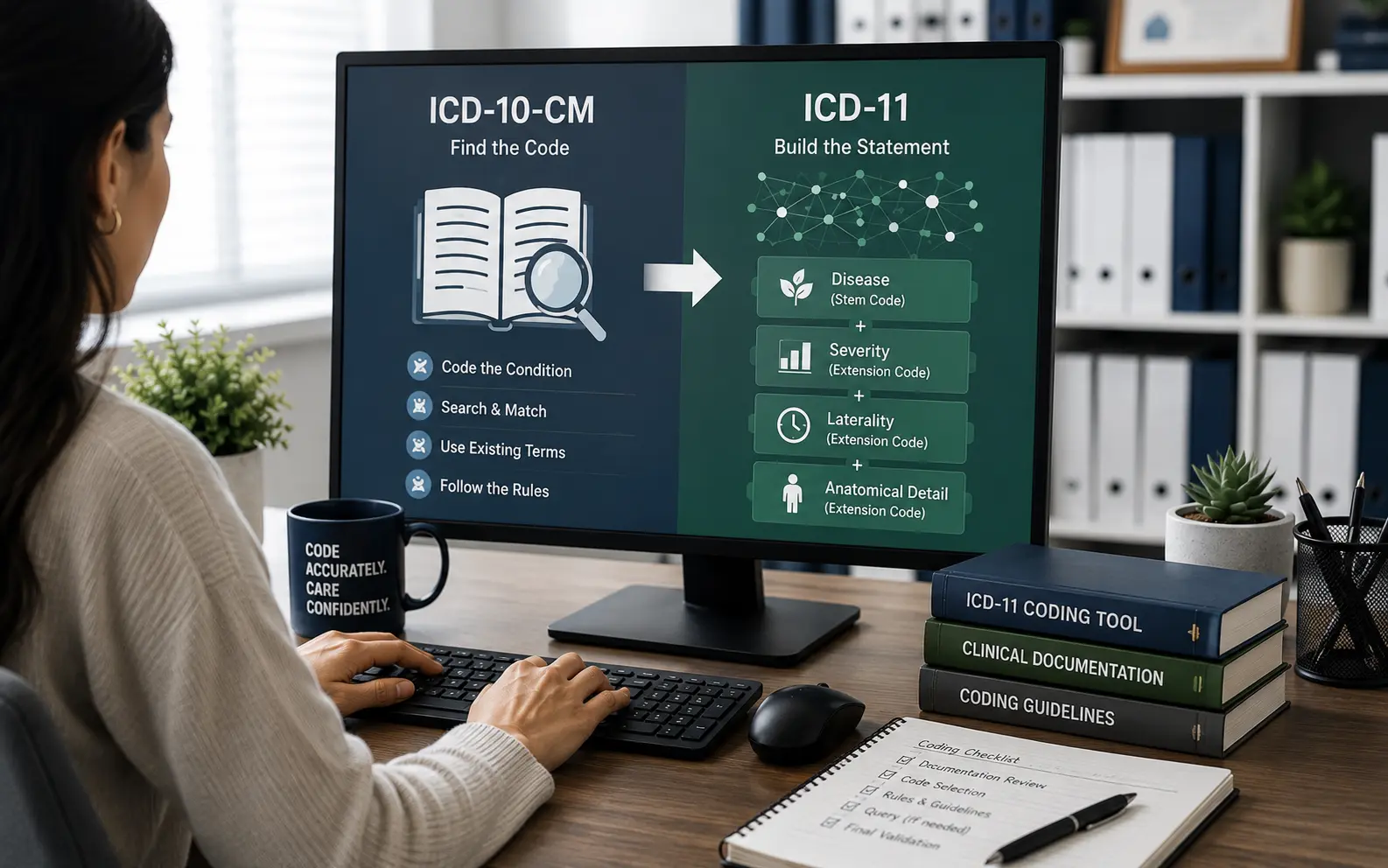
ICD-11 doesn't run on that same lookup logic. It's built as a digital-first, browser-based classification with API connectivity, designed to work directly with electronic health records and support automated coding assistance rather than a static index-and-tabular-list search. Instead of hunting for a single term that leads you to one finished code, the workflow becomes identifying the correct stem code and then actively deciding whether extension codes are needed to capture the full clinical picture. That's not a faster version of the old habit. It's a different kind of decision-making, closer to assembling a description than looking one up.
Habit Two: Hunting for the One Code That Says Everything, ICD-11 and More Detailed Clinical Coding
In ICD-10-CM, the goal is almost always to find the single precoordinated code that captures the complete diagnosis, site, laterality, severity, and all. ICD-11 flips that expectation. Its post-coordination model means a base stem code gets linked with one or more extension codes to build the full clinical picture, rather than searching for one code engineered to say everything at once.
A duodenal ulcer with active gastrointestinal bleeding, for example, isn't captured by a single precoordinated code the way it would be in ICD-10-CM. It's built by linking two stem codes together. Tuberculosis of the prostate is built by linking a stem code to a specific extension code that adds the anatomical detail. This is a genuinely different mental model. Instead of asking "what's the one code for this," the ICD-11 question becomes "what's the base concept, and what needs to be added to it."
Habit Three: The Excludes1 Reflex, What ICD-10-CM Coding Rules Can Teach Us About ICD-11
Every ICD-10-CM coder has internalized the Excludes1 and Excludes2 distinction almost as muscle memory. Excludes1 means two conditions can never be coded together. Excludes2 means they can coexist and both codes are acceptable. That binary rule structure is baked directly into the ICD-10-CM tabular list itself.
ICD-11 doesn't organize its relationships the same way. It's built around a much larger underlying ontology, referred to as the Foundation Component, with its own hierarchies and relational structure that doesn't map cleanly onto the familiar Excludes1 and Excludes2 convention. This doesn't mean ICD-11 has no exclusion logic. It means the specific reflex of "I remember this is an Excludes1, so I never code both" is an ICD-10-CM-specific habit tied to that book's particular structure, and it needs to be consciously re-evaluated rather than assumed to carry over automatically.
Habit Four: The Chapter Map in Your Head, Navigating ICD-11's New Medical Coding Structure
Experienced coders carry a mental map of where things live. Chapter numbering in ICD-10-CM uses Roman numerals, and coders know roughly which chapter houses which body system or condition type without needing to look it up every time.
ICD-11 reorganizes this in a few specific ways worth knowing before you rely on old muscle memory. Chapter numbering switches from Roman numerals to Arabic numbers. The classification is organized into 26 chapters that broadly follow the traditional ICD pattern of etiology, organ system, and external causes, but the internal distribution of codes within those chapters isn't uniform, and some content moved to genuinely new locations. Conditions related to sexual health, for instance, were reorganized out of the categories where ICD-10 placed them and into their own dedicated area. Growth also wasn't even across the board. Comparative research found that chapters covering symptoms and signs not elsewhere classified grew by 217 percent in code volume, blood and immune system disorders grew by 157 percent, and eye and adnexa conditions grew by 135 percent, while two chapters, musculoskeletal conditions and external causes of morbidity, actually ended up with fewer codes in ICD-11 than they had in ICD-10. A coder's instinct for "I know roughly where this lives" needs to be rebuilt, not assumed.
Habit Five: Waiting for the New Book, Why ICD-11 Preparation Goes Beyond Buying a New Code Set
Every past code set transition has followed a familiar rhythm. A new annual edition gets published, coders get a training period, and everyone adjusts to the updated book or software release. That rhythm doesn't apply to ICD-11.
ICD-11 updates continuously online rather than through periodic annual print or software editions. There's no single moment where "the new book arrives" and training can begin in earnest. Preparation has to happen more like an ongoing familiarity project, tracking how the online classification evolves, rather than a scheduled cutover tied to a single new resource landing on your desk. Coders and educators waiting for a defined moment to "start learning the new edition" are waiting for something that doesn't quite work that way under ICD-11's digital, continuously updated structure.
Habit Six: Assuming Procedures Come Along for the Ride, Understanding ICD-11 Diagnosis Coding vs. Procedure Coding
This is a genuinely easy assumption to make, and it's worth correcting directly. ICD-10-CM handles diagnosis coding, and ICD-10-PCS, a separate system, handles inpatient procedure coding in the U.S. Coders naturally think of these as a matched pair.
Here's the part that surprises people: ICD-10-PCS was never a World Health Organization product. WHO's ICD-10 never included a procedure classification at all. The United States built ICD-10-PCS independently, specifically for domestic inpatient procedure coding, entirely separate from WHO's diagnosis-focused classification. ICD-11, as released by WHO, follows the same pattern. It's a diagnosis classification. It doesn't come bundled with a procedure coding system. Whatever eventual procedure coding pairs with ICD-11 in the U.S. would need to be independently developed or maintained, the same way ICD-10-PCS was, rather than assumed to already exist as part of the WHO release.
The Habit That Will Hurt the Most: Crosswalk Thinking
Of everything in this list, this is the one worth internalizing most seriously. When ICD-9 transitioned to ICD-10, General Equivalence Mappings gave coders a rough, if imperfect, one-to-one or one-to-many bridge between the two systems. It's natural to assume something similar will exist for ICD-10-CM to ICD-11, and to plan on leaning on it heavily.
Research examining this directly found that only 23.5 percent of a sample of 943 common ICD-10-CM codes had an exact single stem code match in ICD-11. That's not a minor mapping inconvenience. That means for roughly three out of every four common diagnosis codes a coder uses regularly, there isn't a clean, single equivalent waiting on the other side. Some concepts split across multiple ICD-11 stem and extension combinations. Others moved into entirely different chapters or conceptual categories. A crosswalk tool will exist eventually, and it will help, but treating it as a reliable one-to-one substitution the way many coders leaned on ICD-9-to-ICD-10 GEMs would be a mistake with real accuracy consequences.
So What Actually Transfers? ICD-10-CM Coding Skills That Still Matter
None of this means starting over from zero. The core professional skills that make someone a strong coder today transfer directly, even though the specific mechanics change.
- Documentation scrutiny. The habit of reading clinical notes closely enough to catch missing detail, laterality, severity, causation, matters even more under a system built around assembling detail through post-coordination rather than less.
- Querying providers for clarification. If anything, ICD-11's extension code model increases the value of a coder who knows when documentation doesn't support the level of specificity a cluster code would need.
- Comfort with structured, rule-based systems. The specific rules change, but the discipline of following a rules-based classification system accurately is the same underlying skill.
- Clinical knowledge. Understanding disease processes, anatomy, and clinical terminology doesn't reset with a new code set. It's the foundation every classification system, old or new, is built on top of.
The specific reflexes covered above need rebuilding. The underlying professional judgment that made those reflexes useful in the first place doesn't.
Common Mistakes Coders Are Already Making About ICD-11
- Assuming a future crosswalk tool will function like ICD-9-to-ICD-10 GEMs, when only about a quarter of common codes have a clean single stem match.
- Treating ICD-11 as "the same system with more codes" rather than a structurally different post-coordination model.
- Assuming Excludes1 and Excludes2 logic will carry over unchanged, when ICD-11's relational structure is built differently.
- Waiting for a defined "new edition" moment to begin any familiarity-building, when ICD-11 updates continuously rather than through periodic releases.
- Assuming a U.S. procedure coding system will simply come bundled with ICD-11, when WHO's release has never included one, for ICD-10 or ICD-11.
- Underestimating how unevenly detail was added across chapters, which makes a uniform mental chapter map unreliable for some specialties more than others.
What to Actually Do Given That There Is No U.S. ICD-11 Billing Deadline
- Build early, low-pressure familiarity with the stem code and extension code model conceptually, without needing a full curriculum or formal training program yet.
- Practice thinking in post-coordination terms occasionally with current, familiar diagnoses, mentally asking "what would the base concept and add-on details be" as a habit-building exercise.
- Follow published comparative research and NCHS materials as they become available, rather than relying on any single vendor's simplified crosswalk claims.
- Keep documentation quality and specificity high under ICD-10-CM now, since that discipline directly supports whatever cluster coding requirements come later.
- Resist over-investing time or budget in deep ICD-11 specialization until a genuine rulemaking timeline exists, given that no mandate or deadline has been published as of this writing.
Expert Recommendations
The coders and RCM teams who come through this transition well won't be the ones who memorized the most ICD-11 codes early. They'll be the ones who understood the conceptual shift, precoordination to post-coordination, index-driven lookup to stem-and-extension assembly, early enough that the eventual formal training feels like refinement rather than a complete rebuild of how they think about the task.
It's also worth treating the 23.5 percent exact-match statistic as a planning input, not just a trivia point. Any organization assuming a future crosswalk will make this transition mechanical is underestimating the work involved. Realistic timeline and staffing planning, whenever a mandate does eventually appear, should account for the fact that a meaningful share of coding decisions will require genuine clinical judgment rather than a lookup substitution.
Finally, given how much of this transition touches documentation requirements before it touches billing mechanics, clinical documentation improvement work done now, under ICD-10-CM, is quietly also ICD-11 preparation. That's true regardless of exactly when, or in what form, a formal U.S. billing mandate eventually arrives.
Frequently Asked Questions
Is ICD-11 just a larger version of ICD-10-CM?
No. ICD-11 uses a fundamentally different post-coordination structure, combining stem codes with extension codes to build detailed clinical descriptions, rather than relying primarily on single precoordinated codes the way ICD-10-CM does.
What is a stem code in ICD-11?
A stem code is the base classification code in ICD-11, which can be used alone or combined with extension codes or other stem codes to add clinical detail like severity, laterality, or anatomical location.
What is an extension code, and can it be used by itself?
An extension code adds specific detail, such as stage, severity, histopathology, or anatomy, to a stem code. Extension codes cannot be used alone and must always be linked to a stem code.
Will there be a reliable crosswalk between ICD-10-CM and ICD-11?
Some mapping tools will likely exist, but research found only about 23.5 percent of common ICD-10-CM codes have an exact single stem code match in ICD-11, meaning a simple one-to-one crosswalk won't cover most coding decisions accurately.
Does ICD-11 use the same Excludes1 and Excludes2 rules as ICD-10-CM?
Not in the same structural form. ICD-11 is built around a broader underlying ontology called the Foundation Component with its own relational structure, which doesn't map directly onto ICD-10-CM's specific Excludes1 and Excludes2 convention.
How many chapters does ICD-11 have compared to ICD-10-CM?
ICD-11 is organized into 26 chapters using Arabic numbering, compared to ICD-10-CM's Roman numeral chapter system, with some conditions reorganized into different chapters and uneven growth in code volume across chapters.
Does ICD-11 include a procedure coding system similar to ICD-10-PCS?
No. ICD-11, as released by the World Health Organization, is a diagnosis classification and does not include a procedure coding system, the same way WHO's ICD-10 never included one. ICD-10-PCS was developed independently in the United States for that purpose.
Why can't coders just rely on their ICD-10-CM index habits under ICD-11?
ICD-11 is built as a digital-first, browser-based classification designed for direct EHR integration and automated coding support, rather than the linear index-and-tabular-list lookup workflow ICD-10-CM coders are used to.
What ICD-10-CM coding skills still matter under ICD-11?
Documentation scrutiny, provider querying for missing clinical detail, comfort with rules-based classification systems, and underlying clinical knowledge all transfer directly, even though the specific coding mechanics change.
Is there a set deadline for switching to ICD-11 in the United States?
No. As of this writing, no formal rulemaking process has begun and no mandatory implementation date has been published for ICD-11 as a U.S. billing code set.
Conclusion
The coders who adapt fastest whenever ICD-11 does arrive won't be the ones who tried to memorize the new code set cover to cover. They'll be the ones who recognized early that the underlying logic changed, precoordination to post-coordination, index lookup to stem-and-extension assembly, a chapter map that needs rebuilding rather than reused. The professional judgment behind good coding doesn't reset. The specific habits built around ICD-10-CM's particular structure do, and knowing which is which now is what actually saves time later.
Sources and Further Reading
- World Health Organization, ICD-11 for Mortality and Morbidity Statistics, who.int
- AAPC Knowledge Center, ICD's Continued Evolution and Impending Transition to ICD-11, aapc.com
- National Committee on Vital and Health Statistics, Workgroup on Timely and Strategic Action to Inform ICD-11 Policy, ncvhs.hhs.gov
- CDC National Center for Health Statistics, ICD-10-CM and ICD-11 Resources, cdc.gov
- National Library of Medicine, comparative research on ICD-10-CM to ICD-11 code mapping, ncbi.nlm.nih.gov
Edge RCM CTA
Whenever ICD-11 does arrive for U.S. billing, the practices and coding teams who adjust fastest will be the ones who understood the conceptual shift ahead of time, not just the ones who bought new software. Edge RCM helps practices build the coding accuracy, documentation discipline, and training readiness that make any future code set transition smoother, while keeping today's ICD-10-CM billing performance strong in the meantime. If you want your coding team genuinely ready for what's structurally different about ICD-11, not just aware that it exists, Edge RCM can help you get there.